
Officers conduct hundreds of license plate lookups every single day. However, many agencies are still using traditional radio-based checks. Officers have to call the dispatcher, and the dispatcher then queries NCIC and the state DMV before relaying the results back to the officer.
Communications have to be repeated, which only unnecessarily eats up precious radio bandwidth and delays response times.
Modern license plate lookup systems eliminate these delays. They allow officers to query a license plate database directly from their vehicles using mobile devices to get warrant information, registration status, and alerts for stolen vehicles faster.
But how exactly do these systems work? What databases do they access? And how do agencies ensure speed without compromising CJIS security?
This guide illustrates how license plate lookup works, explaining the technology behind the system, from database architecture to mobile query processing. It helps law enforcement agencies understand how modern platforms deliver intelligence in real time, while also maintaining compliance and security requirements.
What Is License Plate Lookup?
A license plate lookup is the process of querying criminal justice and motor vehicle databases using license plate numbers to retrieve information about the vehicle and the owner. It’s also commonly known as a plate query or a vehicle search.
The technology for license plate checks has come a long way. Years ago, officers had to call dispatchers and wait for 35 seconds to 2 minutes. Today, mobile self-service tools return results in as fast as 17 seconds. This significantly improved officer efficiency in the field and, just as importantly, enhanced safety by delivering critical information on time.
What Gets Retrieved
- Registration of vehicles containing the name and address of the owner
- Stolen vehicle status listed in the NCIC stolen vehicle file
- Outstanding warrants associated with the registered owner
- Status of vehicle insurance depending on the state
- History indicating prior law enforcement contacts involving the car
- Description of the vehicle to verify the make, model, color, and VIN
Who Conducts These Queries
- Traffic stop patrol officers
- Dispatchers during 911 calls
- Detectives investigating crimes
- Automated License Plate Reader (LPR) systems
- Parking enforcement officers
- Border patrol and checkpoint operations
Legal Authority
Plate checks are restricted to authorized law enforcement personnel and must always be tied to a legitimate law enforcement purpose. Every query is logged, monitored, and subject to audit to meet CJIS compliance standards.
Using the system for personal reasons, like an officer running plates on ex-spouse or family members, is against policy. This will consequently lead to internal investigations and serious legal consequences for the officer, including certification suspension or even termination. The agency’s reputation and public trust might also suffer.
Systems like PsPortals include built-in audit logging to ensure every query is tracked and compliant.

Core Databases Accessed During Plate Queries
When a license plate is entered, modern systems run searches across multiple data sources simultaneously. They pull data from the NCIC, state DMV databases, state criminal justice repositories, and local agency records.
NCIC (National Crime Information Center)
This is the central database of the FBI. The NCIC is used to verify stolen cars and license plates across millions of records. It also identifies wanted persons associated with the vehicle, along with vehicle identification number (VIN) theft records.
State DMV / Motor Vehicle Databases
State DMV and motor vehicle databases are typically the first resource used during a plate check. They provide key details such as current registration status, registered owner information, vehicle description, expiration dates, and, where available, insurance status.
This information is accessed via Nlets (International Justice and Public Safety Network), which securely connects law enforcement agencies to motor vehicle records across state lines.
State Criminal Justice Databases
State criminal justice databases track local legal statuses and active warrants that don’t appear in federal systems. These databases allow officers to view a registered owner’s state-specific warrants, criminal records, and vehicle alerts. This is crucial for identifying local threats during routine traffic stops or investigations.
Local Agency Databases
Local agency databases are checked for previous calls for services involving the vehicle, local BOLO (Be On the Lookout) alerts, impounds and towed logs, and field interview records (FIRs).
By aggregating (and then querying) this locally held information, the agency can monitor vehicles of interest in currently active cases, even though they may not have met state or Federal requirements for reporting.
Query Speed
Thanks to the parallel processing capabilities of modern systems, multi-database queries can be conducted at the same time. Within about 15 to 30 seconds, officers can gain consolidated data to keep them updated and safe. Cops won’t have to wait 3 to 5 minutes for traditional sequential license checks.
How License Plate Lookup Technology Works (Step-by-Step)
Modern technology has made license checking pretty straightforward. Instead of time-consuming dispatcher-mediated queries, modern policing has moved to a fast and secure three-step process.
To help picture out the process, this section follows a common real-world scenario wherein an officer is conducting traffic stops in the middle of the city.
Step 1: Officer Enters Plate
License plate checks begin when an officer types in a plate number using tools like a mobile app on a smartphone, a Mobile Data Terminal (MDT), a CAD-integrated query interface, or an Automated LPR system.
Once the plate number is entered, automated validation and direct-entry systems initially check the format to match the plate number with the corresponding patterns of known states. For example, California has a standard pattern consisting of one digit, three letters, three digits (7ABC123).
However, with dispatcher-mediated queries, radio signals can become choppy in the city’s congested areas. Dispatch might mishear a single digit in the plate over the radio due to static.
As a result, they run the wrong vehicle, and the officer approaches, believing the registered owner is free from warrants. In reality, the actual vehicle belongs to a man with an active warrant, which exposes the officer to danger.
License plate lookup technology prevents transcription errors, making sure officers act on accurate intelligence before they exit the patrol car.
Step 2: System Queries Databases
After the plate is entered and validated, modern platforms then conduct a millisecond search in each database system to find an exact match. A no-hit or hit response is then returned to the system.
Such a reply contains all the related owner and vehicle information. Officers can proceed with the next check, and the driver won’t have to be stuck in traffic on a busy day.
In contrast, officers have to wait for dispatchers to query databases for radio-based license checking. This creates traffic congestion, especially during rush hours.
Step 3: Results Appear in Seconds
With license lookup technology, all the various responses from different databases are gathered into one interface in as little as 15 seconds. Officers gain a holistic profile of the vehicle and its owner with critical information highlighted.
Query results aren’t returned as fast for agencies still using traditional methods. Officers still have to wait in line for radio transmission, which could be disrupted by signal interference and the loud noises of the surrounding city.
Audit Logging and Security
Beyond helping police receive timely information in the field, license plate lookup technology also documents the entire transaction in the background.
Every query is automatically logged, recording who ran it, when it was done, and which plate was searched. The system also keeps track of which databases were used, what information was returned, and even the exact device that was used.
This automated auditing capability is especially critical in fast-paced traffic stops in the middle of the city, as officers and dispatchers won’t have to retype every detail for each query manually. Agencies can adhere to CJIS security requirements and maintain comprehensive audit trails for all Criminal Justice Information (CJI) access.
Security Layers
Modern systems use a multi-layered security architecture to help safeguard sensitive law enforcement data.
Encrypted transmission of all data via the TLS 1.3 protocol secures data in transit. Multiple-factor authentication (MFA) prevents any unauthorized access to criminal justice databases. Verification of NCIC operator certification ensures that only recognized personnel can use license check lookup systems.
Recently, many platforms are also employing zero-footprint security, so data of queries and results are never locally stored on mobile devices to minimize the risk of data breach.
Manual vs. Automated License Plate Lookup
The development of law enforcement technology has transformed day-to-day police work. This section compares the primary methods of license plate checking: manual, mobile, and automated.
Manual (Traditional) Lookups
In the past, license plate checks were largely handled through dispatch. The process usually goes:
- Officer radios dispatcher with license plate number.
- The dispatcher manually enters the plate into the terminal.
- Dispatcher queries NCIC and state DMV.
- The dispatcher waits for results (30 seconds to 2 minutes).
- The dispatcher relays results to the officer via radio.
- The officer proceeds based on the information.
The limits of manual lookups are most evident during peak hours when a dispatcher has to juggle multiple 911 calls while simultaneously running plate checks for officers in the field.
Radio channels become congested, and queries consume too much time. The risk of transcription errors and lost details increases as dispatchers have to rush to catch up to each call. And when a more urgent emergency call comes in, plate checks are pushed to pending, and officers have to wait, unsure of the situation in front of them.
Modern Mobile Lookups
Modern license plate lookup workflows use mobile technology to bring data access closer to officers in the field
- The process begins when an officer enters a plate number directly into a mobile app.
- The system then triggers a simultaneous automated license plate database search across federal, state, and local repositories.
- Results are then sent to the officer’s device in real time (15 to 30 seconds).
- Officers can review the vehicle and owner information independently.
Under the same pressure during peak hours, modern mobile systems deliver several advantages. Instead of calling dispatch and waiting through heavy radio traffic, officers can query the plate number directly using mobile devices.
Within seconds, the complete vehicle and owner information is ready with improved accuracy because verbal relay errors are eliminated. The radio channel remains open for priority emergencies, and the officer makes an informed decision before stepping out of the patrol car.
Automated License Plate Recognition (ALPR)
Automated License Plate Recognition, or ALPR, is perhaps the most advanced license-checking technology. Using high-speed cameras paired with Optical Character Recognition (OCR), they automatically read the plates of passing vehicles without anyone having to press a button.
These systems can scan thousands of plates every hour and compare each one to the right databases in real time. The system tells the officer right away if a plate matches a stolen car, a wanted suspect, or an alert list. There’s no need to call it in, so they can respond faster and with more information.
ALPRs can be mounted directly on patrol vehicles, turning them into mobile scanning units, or installed in fixed locations like intersections, highways, and parking lots. In practice, they’ve become a critical tool for recovering stolen vehicles and supporting AMBER or Silver Alerts by helping pinpoint vehicle locations.

License Plate Lookup API and Integration
Modern license plate query systems are interconnected and utilize an API (Application Programming Interface). This interface allows different software systems to communicate effectively. Law enforcement agencies can implement several necessary integrations using this technology.
Common Integrations
CAD (Computer-Aided Dispatch)
Dispatchers can query plates without leaving the CAD interface, and the results are automatically documented in incident records without having to switch between disparate systems.
RMS (Records Management)
When RMS is fully integrated, officers can query a plate, and the system automatically pulls that vehicle information directly into the report. So, by the time the license check is complete, much of the report is already populated.
That means no retyping the same details, which saves data entry time and reduces manual errors.
Mobile App Integration
Mobile integration has opened up several practical options for law enforcement agencies, depending on how they operate during license checking.
Some use standalone mobile plate lookup apps to gain focused yet straightforward tools that allow officers to run queries directly from a smartphone or tablet in the field.
Others take it a step further by integrating Software Development Kits (SDKs) into their existing agency mobile applications, so plate checks become a built-in feature rather than a separate tool.
In many jurisdictions, plate queries are now embedded directly into e-citation systems. Officers can run a lookup as part of the citation process without switching platforms. Vehicle and owner data are automatically pulled into the ticket, ensuring citations are accurate and legally defensible.
ALPR Systems Integration
ALPR system integration automates queries when the license plate reader captures plate numbers. Each scan is checked in real time against hotlists, including stolen vehicles, wanted persons, and other flagged entries. If there’s a match, the system immediately generates an alert and routes it to the nearest available units.
API Requirements for Law Enforcement
Law enforcement is a strictly controlled environment to protect public security and safety. As such, APIs must also adhere to stringent requirements.
- CJIS-compliant API security: Law enforcement systems that access CJI must follow the CJIS Security Policy without exception. Access controls, authentication methods, full auditing, and policies must all follow the rules for protecting Criminal Justice Information (CJI).
- Encrypted API calls (HTTPS/TLS): Every API call should be encrypted using HTTPS with TLS (1.2 or higher) to ensure data remains protected in transit.
- Authentication token management: Authentication tokens must be issued, checked, and changed in a safe way. It should also be taken away from people who aren’t authorized.
- Comprehensive API call logging: Every query to check licenses should be recorded to maintain a defensible audit trail, including who made it, when it was made, what license was queried, where it was accessed, what device was used, and the outcome.
- Rate limiting for system protection: Rate limiting restricts how many requests someone makes during a period of time. It helps protect law enforcement systems, preventing abuse, overload, or accidental spikes that could impact availability.
Limitations of Free License Plate Lookup Tools
There are plenty of “free license plate lookup systems” online, but agencies should be cautious in using these websites.
Not only do they provide limited DMV information and lack access to NCIC or criminal justice files, but these tools are also not compliant with CJIS standards.
Consumer-grade tools cannot be relied upon to ensure secure and audited access for law enforcement purposes.
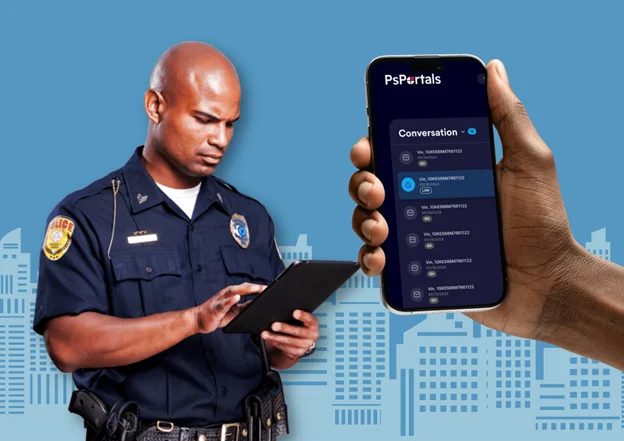
PsPortals: Instant Mobile and Desktop License Plate Access
Plate queries are part of everyday policing. They happen during traffic stops, in the middle of 911 calls, while working active investigations, and when responding to suspicious vehicle reports.
For agencies still using radio-based checks, every query costs up to 5 minutes of officer time and clogs dispatch channels. PsPortals eliminates this bottleneck by putting instant database access in officers’ hands.
That’s where purpose-built tools matter. PsPortals delivers CJIS-compliant plate lookup capabilities across both mobile and desktop platforms, designed specifically for law enforcement database access..
Portal XL (Dispatch and Desktop)
Portal XL is a web-based solution built with dispatch centers, detective bureaus, and records divisions in mind.
- Direct NCIC/NLETS Access: Through a single interface, users can directly access NCIC and Nlets to query stolen vehicle files, state DMV records, and warrant databases.
- CAD Integration: Plate lookups can be embedded directly into Computer-Aided Dispatch systems, allowing dispatchers to run queries without ever leaving their CAD screen.
- Zero Installation: Because it’s entirely web-based, Portal XL requires zero local installation on individual workstations. It runs securely through CJIS-approved browsers like Chrome, Edge, Firefox, and Safari.
- Multi-Database Parallel Queries: The platform also performs multi-database parallel queries, searching NCIC, Nlets, and relevant state systems simultaneously with results typically returned within 15 to 30 seconds.
Personal Portal (Mobile Access)
This application is designed for field officers and is compatible with both Android and iOS devices.
- Field Independence: Officers can run plate lookups themselves. They do not need to wait until a dispatcher is free.
- Zero-Footprint Mobile: Findings are only displayed on the screen and are not stored on the phone. In the event of a lost phone, no sensitive information is compromised.
- Full Disclosure: Officers are given the complete search details, and not merely given a briefing on the radio.
- Instant Results: License lookup results are returned in as fast as 15 to 30 seconds from a patrol vehicle or on foot.
Why PsPortals Specifically for Plate Queries
Legacy systems force agencies to choose between speed and security. PsPortals delivers both with browser-based access that maintains CJIS compliance while cutting query times from 3 minutes to 15 seconds.
Speed Without Compromising Security
With more than 30 years of experience optimizing database queries, PsPortals can deliver sub-30-second response times for complex multi-database queries.
Delivered via a CJIS-oriented architecture that uses TLS 1.3-encrypted transmission, ensuring speedy data retrieval without compromising security.
Comprehensive Automatic Audit Logging
To ensure high accountability, plate lookups are automatically logged, including the user, date and time, plate number, databases searched, and device used.
Officers can focus more on active patrol rather than paperwork. The system offers audit-ready exports for CJIS compliance. It also has a real-time monitoring feature to identify improper queries, e.g., an officer running their own plates or relatives.
True Mobile Independence
PsPortals provides officers with the autonomy to perform their own lookups without relying on dispatchers. This change saves about 2 to 3 minutes per lookup, and reduces radio congestion by removing “run this plate” requests.
This represents 30 to 45 minutes of patrol time recovered each day by every officer, when multiplied by an average of 15 daily lookups.
Zero-Footprint Architecture
Security is ensured by a zero-footprint design that stores zero Criminal Justice Information (CJI) on mobile devices. The query results are displayed in real time but are never stored on the equipment.
No sensitive data can be compromised, and no CJIS violation can occur in the event of a lost or stolen device. Also, they offer remote wipe, an added security feature.
Integration Flexibility
PsPortals is versatile and provides APIs that enable easy integration with CAD/RMS. The platform can accommodate the department’s specific technical environment, whether used as a standalone tool or integrated into the agency’s current systems.
Officer Safety Enhancement
PsPortals is used to ensure that officers know information about warrants and make timely tactical decisions before they approach a vehicle.
For instance, when an officer initiates a routine stop for a broken taillight. Before exiting the vehicle, a mobile plate lookup reveals that the registered owner has an active felony warrant and a history of weapons charges. Instead of conducting a standard approach, the officer calls for backup and transitions to a high-risk stop procedure.
PsPortals SaaS Platform Advantage
Being a cloud-based product, PsPortals does not require agency servers and offers a consistent subscription pricing framework that does not require significant capital investments. The site has 99.9%+ availability, geographical redundancy in case of a disaster, and automatic security patches, ensuring the system is never obsolete.
Multi-Agency Capability (Super Administrator)
The Super Administrator module is designed to provide centralized plate lookup logging and consistent compliance monitoring for counties and regions overseeing various departments. This ensures uniformity in query standards across the county and facilitates regional stolen vehicle alerts.
NCIC Certification Management (Testing & Certification Module)
The integrated Testing & Certification Module ensures that only authorized personnel conduct lookups. It also automatically monitors the certification status and prevents uncertified users from accessing NCIC, and provides agencies with audit-ready certification reports on a moment’s notice.
License Plate Lookup Best Practices for Agencies
Agencies should adhere to these best practices to optimize efficiency and maintain security.
1. Verify CJIS Compliance
Verify that the agency’s systems comply with all CJIS Security Policy requirements. Vendors must also sign the CJIS Security Addendum to prove their commitment to compliance.
MFA should be enforced, comprehensive audit logging should be automated, and encryption standards for data in transit should be a minimum of TLS 1.2.
2. Implement Mobile Access
Equip officers with the ability to perform license plate lookups independently. This reduces the dispatcher’s workload by 40-60 percent, improves officer safety with immediate intelligence, and boosts operational efficiency.
3. Enforce Operator Certification
Verify NCIC operator certification for officers who need to access criminal justice databases. Automated tools like PsPortals’ Testing & Certification prevent uncertified queries and proactively track certification expirations.
4. Monitor Query Patterns
Review audit logs regularly to identify potential issues. Automate flagging of suspicious patterns and be cautious of off-hours queries or searches that appear to be personal in nature.
One of the most common violations found is when an officer repeatedly runs late-night queries tied to vehicles registered to their friend or family member. This behavior should be promptly investigated, and disciplinary actions must be imposed when necessary.
5. Integrate with Existing Systems
A modern license plate lookup SaaS platform shouldn’t operate in a silo. The system should be able to connect with existing systems, especially CAD and RMS.
Avoid standalone tools that require separate logins or force users to toggle between screens, as they tend to slow things down. In a fast-moving environment, that kind of inefficiency adds up quickly.
Opt for API-enabled platforms. They allow agencies to embed plate lookup functionality directly into existing systems to simplify integration.
6. Select Zero-Footprint Mobile
Zero-footprint architecture, like that of PsPortals’ Personal Portal, is the most effective way to enhance mobile security.
During everyday policing operations, there’s always a risk that mobile devices might get lost or stolen. An officer patrolling a busy road might misplace their department-issued phone. In traditional systems where data may be cached or stored locally, that loss could trigger a full security incident and CJIS compliance violations.
But with a zero-footprint architecture, no CJI is locally stored on the device, which means no query history and no trace of sensitive data. Agencies can prevent the risk of a data breach and compliance exposure.
7. Measure Efficiency Gains
To justify the use of technology, set a baseline for current lookup times and monitor progress after implementation. Divide the amount of time saved during the course of the shift by the amount of time the patrol is spent, and record this ROI. These measurements are essential for soliciting future budgetary allocations or for justifying departmental productivity to stakeholders.
FAQ: License Plate Lookup Systems
How does a license plate lookup work in law enforcement?
A license plate lookup in law enforcement is a quick way for officers to identify a vehicle and check if there are any legal or safety concerns tied to it. It can be done manually or automatically with the help of license-checking technology, querying federal, state, and local criminal justice and DMV databases.
What databases are searched during a plate query?
Inquiries are usually verified against NCIC (federal), Nlets (interstate), state DMV, and local agency records. This offers a thorough overview of the vehicle and its owner.
Can officers perform mobile device lookups?
Yes, police can use modern applications on smartphones or tablets to run license plates. This enhances safety as they receive information immediately before exiting the patrol car.
Are free license plate lookup tools legal for law enforcement use?
While browsing is not technically “illegal,” free license plate lookup tools do not comply with CJIS standards for official investigations. They lack the necessary criminal background checks and do not provide the required audit trails.
Modernizing Plate Checks for Speed and Security
License plate lookup technology has advanced significantly over the past few years. It has transitioned from slow radio calls to instant results available on cell phones. Modern policing relies heavily on this transformation. What used to take five minutes can now be accomplished in just 15 seconds, saving nearly an hour of patrol time for each officer every day.
Technology like this typically runs on CJIS-compliant platforms, processing data from several sources at once, including NCIC, Nlets, plus state and local databases. Results show up quickly on mobile devices or desktop terminals, right when they’re needed. And thanks to zero-footprint architecture, agencies can keep security tight while still delivering the speed people in the field rely on.
For agencies that continue to use traditional methods, the costs of inefficiency are clear. Valuable communication and patrol time are being wasted, and officer safety is compromised.
Take a close look at the current plate-query process. How long does each search actually take? When multiplied by daily query volume, the amount of patrol time lost can add up fast.
Ready to move your agency beyond radio-based lookups? See how PsPortals delivers the speed and compliance your team needs.