
Agency Operations & Efficiency
NCIC Operator Certification: What Your Agency Needs to Know
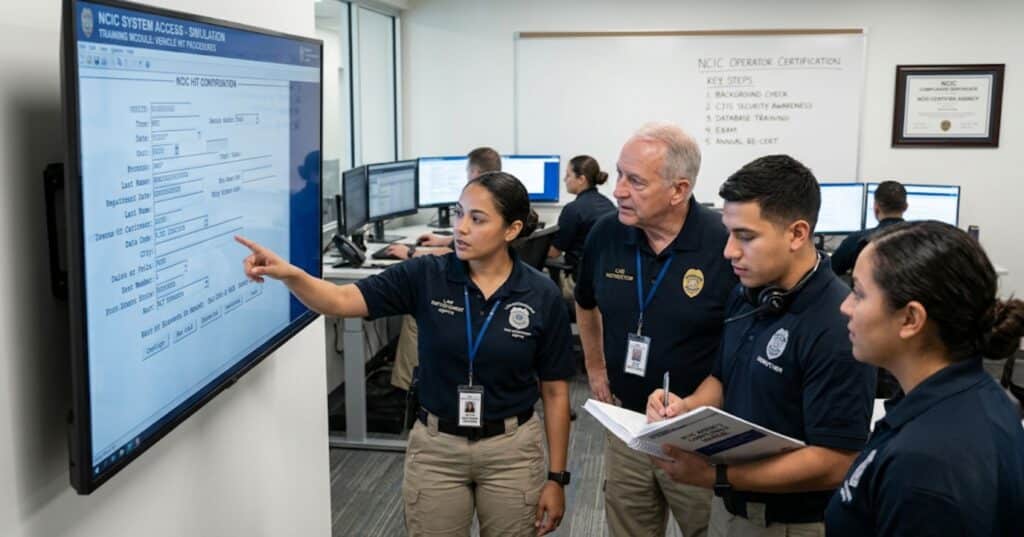
NCIC operator certification is the mandatory qualification that law enforcement personnel must hold before they can query the FBI’s National Crime Information Center databases. It’s not optional, and it applies to every person in your agency who performs hands-on-keyboard access to NCIC systems.
For IT directors, Terminal Agency Coordinators (TACs), and CJIS Systems Officers (CSOs), managing the certification process across an entire agency is an ongoing administrative responsibility. Understanding NCIC compliance and security requirements is essential to keeping your operators qualified and your agency’s database access active.
This guide covers who needs certification, what the process involves, how recertification works, and what happens when certification management falls behind.
Who Needs NCIC Operator Certification
Certification is required for any personnel who directly access NCIC or state criminal justice information systems. The CJIS Security Policy defines these as “hands-on-keyboard” operators. This includes:
Law enforcement officers who run criminal history checks, warrant queries, or person/property lookups
Dispatchers who process NCIC queries on behalf of officers in the field
Records staff who enter, modify, or retrieve data from NCIC files
Administrative personnel with direct system access for compliance or oversight purposes
If a position involves querying, entering, or modifying records in NCIC, the person holding that position must be certified. There are no exceptions based on rank, seniority, or frequency of use.
Prerequisites Before Certification
Before an individual can begin the certification training and exam process, several prerequisites must be completed:
Agency sponsorship: The individual must be formally sponsored by an employing law enforcement agency or authorized criminal justice agency. Self-registration is not possible.
Background investigation: A fingerprint-based background check is mandatory under the CJIS Security Policy for anyone who will have unescorted access to Criminal Justice Information. This screening must be completed before system access is granted.
This is one of the foundational CJIS compliance requirements that applies uniformly across all states.
State CJIS system registration: The agency registers the individual with the state CJIS Systems Agency (CSA). Each state manages its own registration and training infrastructure.
Training authorization: Once registered and cleared, the individual is authorized to begin the state-approved NCIC training program.
The specific timeline and process steps vary by state. Your agency’s TAC or CSO can provide the local requirements. Under the CJIS Security Policy, initial training must be completed within six months of assignment to a position requiring NCIC terminal operation.
What NCIC Certification Training Covers
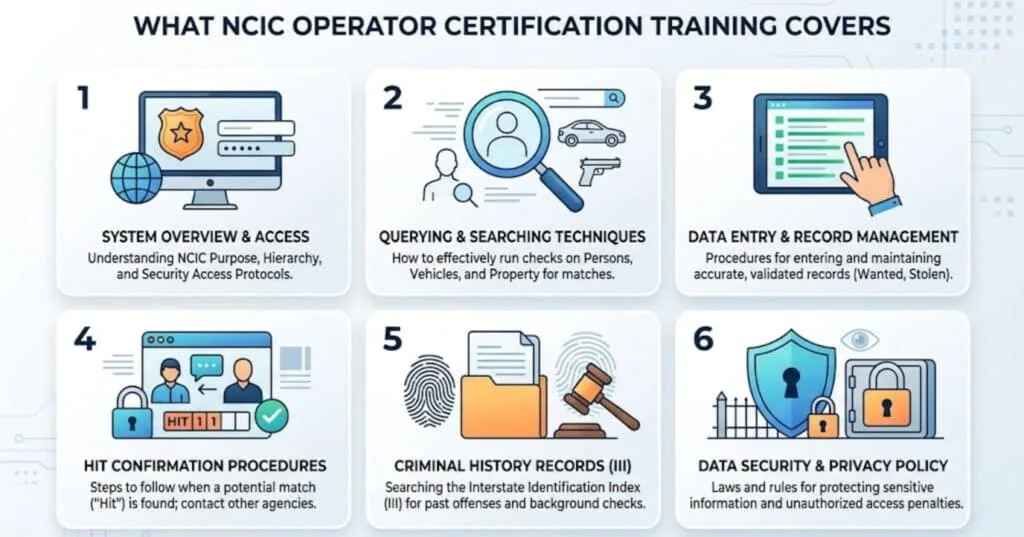
Each state administers its own NCIC training program through the state CJIS authority. While the format and duration vary, the core curriculum covers the same foundational areas:
System navigation: How to query NCIC databases, interpret results, and use the correct message keys and transaction codes for different record types.
Legal and compliance rules: CJIS Security Policy requirements for data access, dissemination restrictions, and the legal boundaries of NCIC use. This includes completing the required
CJIS Security Awareness Training as a prerequisite for database access.
Security protocols: Password management, multi-factor authentication, session handling, and the procedures for reporting security incidents.
Practical application: Scenarios involving record queries, hit confirmation procedures, data entry validation, and proper handling of responses from NCIC and state systems.
Training programs typically combine online modules with instructor-led sessions. The duration varies by state, ranging from several hours to multiple days depending on the certification level and the state’s training structure.
The NCIC Certification Exam
After completing the training program, the individual takes the NCIC certification exam to demonstrate proficiency.
Exam format
The exam is typically a multiple-choice test administered through the state’s approved online testing platform. The number of questions varies by state. Subject areas include database usage, hit confirmation procedures, CJIS compliance rules, data entry validation, and security protocols.
Passing requirements
Under the CJIS Security Policy, a score of 70% or higher is required to pass. Some states set higher thresholds. Retake policies vary by state, so preparation before the first attempt is important.
Certification activation
Passing the exam alone does not complete certification. The individual’s background clearance must also be confirmed by the agency before certification becomes active and system access is granted.
The Recertification Process
NCIC certification is not permanent. The CJIS Security Policy requires that certified operators be retested biennially (every two years) to maintain their qualification. Some states may have additional or more frequent requirements.
Recertification involves:
Refresher training: Updated material covering system changes, new policy requirements, and any modifications to NCIC file structures or procedures since the last certification cycle.
Retaking the exam: Demonstrating continued proficiency in system usage, compliance rules, and security protocols.
Maintaining eligibility: Continued employment in a qualifying position, valid fingerprint records, and no disqualifying events on the individual’s background.
What happens when certification expires
If an operator’s certification lapses, their access to NCIC and related criminal justice databases must be suspended until recertification is completed. This can directly impact agency operations, particularly for dispatchers and officers who depend on secure criminal database access during every shift.
Agencies that track certification expirations proactively, with advance reminders and scheduled recertification windows, avoid the operational disruption of unexpected access suspensions.
The Administrative Challenge of Managing Certification Across an Agency
For a small agency with a handful of operators, tracking certification dates and scheduling exams is manageable. For mid-to-large agencies with dozens or hundreds of certified operators across multiple shifts, the administrative workload grows quickly.
TACs and CSOs are responsible for:
Tracking certification and recertification dates for every operator
Scheduling exams without disrupting shift operations
Confirming that background clearances remain valid
Maintaining audit-ready records of all certification activity
Responding to state CSA inquiries about operator compliance status
When this tracking is done manually through spreadsheets and calendar reminders, certifications slip through the cracks. An operator whose certification expired without notice can lose database access at the worst possible time. Agencies following IT audit best practices keep certification records centralized and current so that auditors see clean documentation, not gaps.
What Certified Operators Access Through Portal XL
NCIC certification qualifies an operator to access FBI criminal justice databases. The platform they use to perform those queries matters just as much as the certification itself.
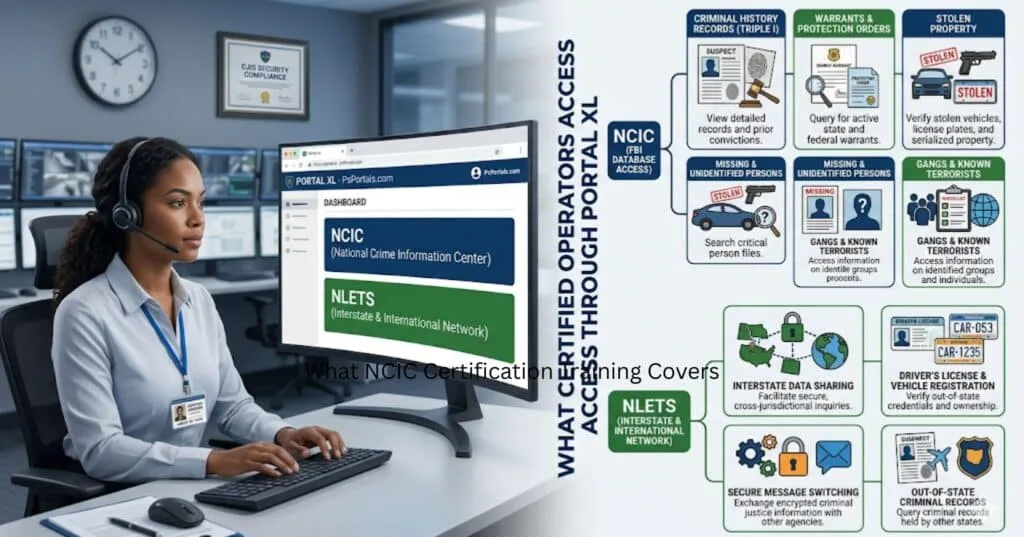
PsPortals Portal XL provides the browser-based interface that certified operators use to query NCIC, NLETS, state criminal history repositories, and local databases. With zero-footprint architecture, Portal XL runs entirely through the browser with no local software installation and no CJI stored on the device.
For certified operators, Portal XL delivers:
NCIC person and property file queries through an intuitive browser interface, replacing legacy terminal emulators and command-line syntax
NLETS interstate message switching for out-of-state criminal histories, driver records, and vehicle registrations
Multi-factor authentication enforced for every session, meeting the CJIS AAL2 requirement
With CJIS-compliant authentication and comprehensive audit logging built into the platform, Portal XL ensures that every query run by a certified operator is documented, traceable, and audit-ready.
Portal XL also supports secure field access on mobile devices, so certified operators can run queries from patrol vehicles and remote locations using agency-approved browsers. The same zero-footprint protections apply: no data stored on the device, no local software to manage.
PsPortals has served law enforcement agencies for over 25+ years, with a signed FBI Security Addendum and 24/7 technical support built for the operational demands of criminal justice agencies.