
According to a 2025 R Street Institute study in the US, the national homicide clearance rate has fallen to about 51% and violent crime clearance rates are under 40% in 2023. This decline can be partly attributed to outdated technology, as many agencies still use fragmented law enforcement systems.
In larger, more decentralized states such as Georgia and Texas, where violent crime clearance rates sit at 30% and 33%, this fragmented system stalls solvable cases. And it’s often not because of missing evidence, but because information is trapped in data silos.
Traditional, disconnected systems create data silos that compromise data quality and information sharing. This results in operational inefficiencies, compliance risks, and missed investigative opportunities for law enforcement agencies.
This guide explains what integrated law enforcement records management is, compares the best options, and shows why agencies choose PsPortals for database integration and compliance.
What is Integrated Law Enforcement Records Management?
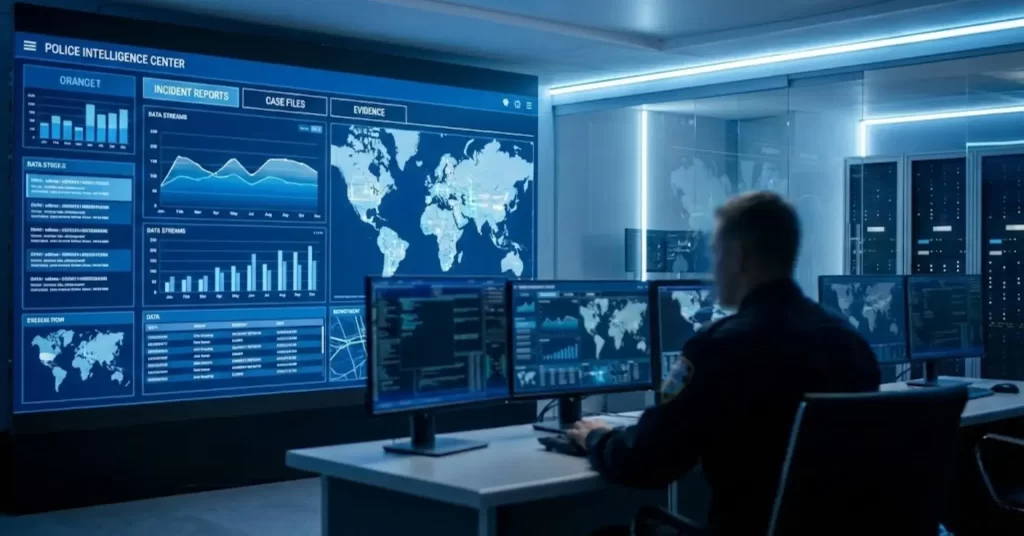
Integrated law enforcement records management system (RMS) is a centralized, often web-based, platform that consolidates all information regarding law enforcement into one unified and cohesive system. This includes incident reporting, case management, evidence tracking, and personnel and administrative data.
Strong integration allows law enforcement officers to access entire criminal justice databases from one platform rather than keeping separate tools for each type of information.
In law enforcement RMS, “integrated” unifies a lot of data and capabilities, including:
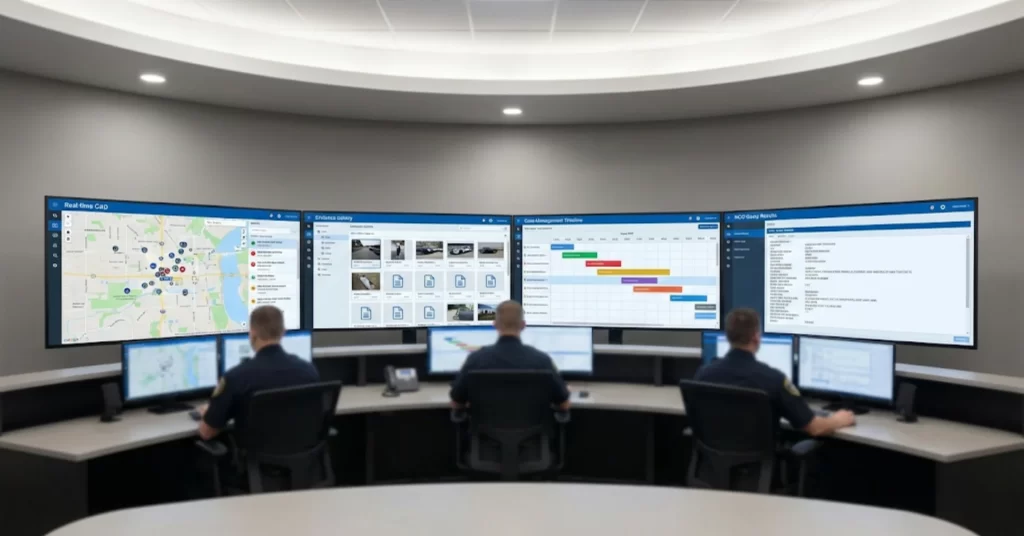
- Computer-Aided Dispatch (CAD) integration – The RMS automatically drafts or pre-populates incident reports of dispatch events near instantly.
- Evidence management – Digital storage of physical and digital evidence with a transparent, trackable chain of custody throughout justice processes.
- Case management – All investigative procedures and timelines gathered in one place.
- Database access – Enables direct querying of NCIC/Nlets networks without system switching.
- Mobile field access – Law enforcement officers can securely access criminal justice data from the field using mobile devices like phones and tablets.
An integrated RMS gets rid of data silos, minimizes the need for duplicate entry, and improves investigative efficiency. Police work is completed quickly, and investigators spot connections a lot more easily.
Information also remains promptly updated and consistent throughout the whole law enforcement information sharing network.
Modern vs. Legacy: Modern cloud-based and browser-accessible RMS are leagues better than on-premise, disconnected systems. With modern RMS, agencies unlock seamless data interoperability and prevent fragmented data silos and operational inefficiencies inherent in legacy systems.
Key Components of an Integrated Records Management System
An integrated law enforcement records management system consists of a number of modules seamlessly working together to effectively handle different types and sources of information. Below are the primary aspects that make up the system’s foundation:
Central Records Repository
All police incident reports, arrests, citations, and field interviews are kept in the central records repository. A master name index connects persons, vehicles, and places through cases, resulting in reduced duplicate records as well as inconsistency in data.
Officers can quickly access complete and accurate individual histories rather than having to look through three different systems.
Criminal Justice Database Integration
An integrated records management system consolidates NCIC and Nlets networks. The NCIC (National Crime Information Center) gives direct access to queries about warrants, stolen property, and missing persons. Nlets (National Law Enforcement Telecommunications System) allows for interstate queries and message switching.
Local and regional RMS are fully connected to the state criminal history repositories, so the officers have instant access to critical information. This means that a stolen-property query that typically takes 15 minutes of checking across two systems now takes a minute or two using one interface.
CAD and Dispatch Integration
With CAD integration, the dispatch system automatically creates case records from reported incidents, enabling bidirectional data flow between dispatch operations and records management. Officers can access real-time unit availability and operational status through a unified interface.
The information from dispatch won’t have to be re-entered into the RMS. There’ll be no delays due to transferring reports and dispatch data between systems.
Evidence and Case Management
Evidence management systems provide secure storage of all digital evidence while ensuring access to tamper-proof documentation supporting a complete chain of custody across the entire life cycle of proof. Case files organize evidence into the appropriate type of electronic evidence such as photos, videos, audio files, etc.
Evidence management systems provide law enforcement with fully documented, auditable, and traceable evidence and support case management through complete visibility into their corresponding timelines and disposition tracking.
They enable law enforcement agencies to quickly fulfil investigative needs and improve their chances for successful prosecution.
Mobile Field Access
Using secure mobile browsers, officers can directly access criminal justice records while being in patrol vehicles. They can share and view reports, photographs, and evidence remotely with a centralized system.
Instant database access enhances situational awareness and the safety of officers. Moreover, zero-footprint architecture implies that no data is stored in mobile devices.
Law enforcement becomes significantly more convenient and faster while maintaining CJIS-compliant data security by using the same authentication and encryption procedures for desktop access.

Why Integration Matters: The Cost of Fragmented Systems
This section explains how disconnected systems create data silos, increase workload and costs, weaken compliance and security, and ultimately slow investigations and case resolution. Disconnected records management software impairs the functioning of an agency in many ways.
Data Silos and Duplicate Entry
Fragmented systems force officers to enter the same information multiple times across different systems. In the case of a traffic stop, dispatch will have to separately enter the event into the CAD, run database queries, and then record the incident in the RMS.
Studies indicate that officers spend a lot of time writing repetitive police reports and administrative tasks. This wastes precious hours that could’ve been used for policing in the community. Manual recording in different systems also risks inconsistency between databases, which compromises data integrity.
Missed Investigative Opportunities
Disconnected systems can hide critical information that could’ve progressed an investigation. Detectives working different cases or jurisdictions cannot see shared data in a single view, so essential patterns go unnoticed.
The same person or event might appear in multiple files, but without a master name index to link those records, investigators may never realize such connections. Criminal cases last longer before being solved, leading to more criminals staying incognito longer than they should. Worse, some crimes may even remain unsolved.
Compliance Vulnerabilities
When activity takes place across a number of systems, audit trail documents aren’t completely and neatly maintained. This makes it hard to monitor audit trails for CJIS compliance.
CJIS security audits may reveal incomplete audit trails, inconsistent access controls, and gaps in logging in fragmented systems. Not only will this lead to mandatory corrective actions and CJI access restrictions, but it also undermines confidence in the agency’s security controls.
Increased Costs
Disconnected systems significantly increase costs for law enforcement agencies. Each system comes with its own vendor relationship, support contract, hardware, and infrastructure, so agencies pay repeatedly to maintain separate on-premise platforms and train officers on multiple interfaces.
Maintaining multiple RMS and point solutions typically costs mid-sized agencies significantly more in licensing, infrastructure, training, and support than consolidating on a single integrated platform such as PsPortals.
PsPortals: The Complete Integrated Solution for Law Enforcement
For over 30 years, PsPortals has been providing law enforcement data management with purpose-built solutions that are specifically designed for criminal justice database integration and CJIS compliance. PsPortals offers a premier integrated RMS solution, dedicating significant depth to product capabilities and unique advantages.
Portal XL Integrated Criminal Records Access
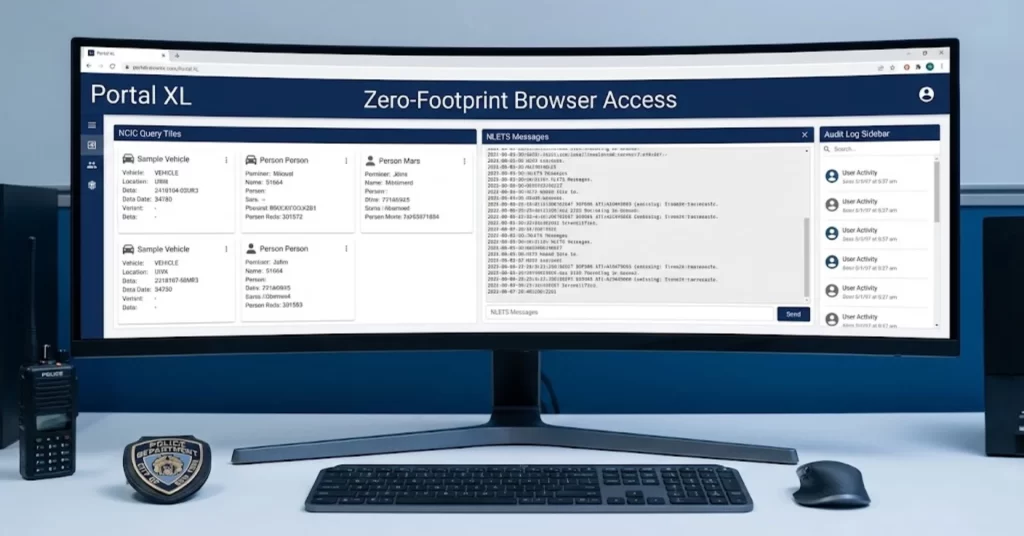
Portal XL serves as the central hub of the PsPortals integrated solution, providing a single interface for accessing connected criminal justice databases and PsPortals applications.
This zero-footprint, browser-based platform requires no software installations, eliminating IT complications and reducing deployment delays.
Portal XL offers the following main features:
- Integration with NCIC, NLETS, and state criminal history repositories
- Single interface for querying local RMS, state, and federal databases
- Codes, identifiers, and required fields are validated in real-time before submission
- Full audit logging to ensure CJIS compliance
- Instant background notifications, even while using other applications
- Enhanced message switching for queries involving multiple jurisdictions
Why Choose Portal XL:
- Eliminates System Switching: Access local, state, and federal law enforcement databases through one interface to simplify information recording and gathering.
- Automated Validation: Minimizes query errors and improves data accuracy.
- Centralized Access: Centralized database access speeds up investigations by reducing time spent switching between systems.
- Zero-Footprint Architecture: Eliminates client-side maintenance and reduces IT-management burden.
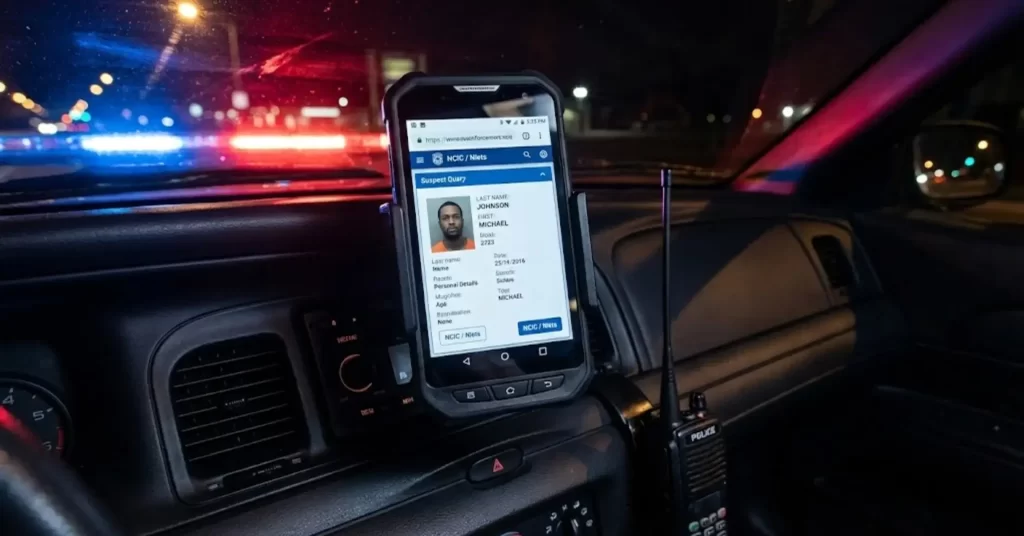
Personal Portal Mobile Integration
Personal Portal carries integrated access far beyond the station limit. The officers get secure access to NCIC and Nlets networks via their smartphones and tablets while on the go.
Personal Portal offers the following mobile advantages:
- The mobile browsers will make it compatible with both iOS and Android
- Zero-footprint security, no data is stored on the devices
- Optimized interface for field efficiency
- Cost-effective use of the existing devices and wireless networks
Why Agencies Select Personal Portal:
- Remote Access: Officers can acquire critical data securely from anywhere in the field.
- Improved Officer Safety: Instant identification of warrants, hits, and alerts improves officer safety during encounters.
- Faster Field Investigations: Field investigation time is reduced by enabling real-time queries without returning to the station.
- Extended Integrated Access: Integrated access extends beyond the station, supporting patrol vehicles and remote operations.
Field reality: The officers on the field respond faster to warrants, stolen property, and wanted persons alerts straight from their patrol vehicles. This quickness is life-saving.
Testing & Certification Operator Management
Testing & Certification automates the processes of administrative compliance. It tracks NCIC operator online certification and recertification with automatic alerts for expiration and status updates.
Testing & Certification offers the following advantages:
- Smooth integration with Portal XL for immediate authorization
- Configurable question banks and passing scores
- Full audit trails for the documentation of compliance
- Reduced workload for test administrators and CJIS System Officer
Why Agencies Choose PsPortals’ Testing & Certification:
- Simplified Certification Management: TACs and CSOs can manage operator certifications more easily from a centralized system.
- Controlled Data Access: Access to criminal justice data is limited to certified personnel and role-based permissions.
- Reduced Administrative Burden: Automated compliance tracking and reminders reduce manual administrative workload.
Super Administrator Centralized Management
The Super Administrator enables unified control of multi-agency operations and management of users, devices, and certifications within a single system.
Super Administrator offers the following features for enterprise scalability:
- Unified control for all PsPortals products
- Ability to manage multiple agencies
- Tools for detailed reporting and supervision
- Customizable role-based permissions and access controls
Why Agencies Prefer PsPortals’ Super Administrator:
- Easier Cross-Department Management: Management across departments becomes straightforward through a single administrative console.
- Standardized Security Policies: Security policies are standardized and enforced consistently across all agencies.
- Support for Large-Scale Operations: The platform supports large-scale operations that span multiple jurisdictions and agencies.
Why PsPortals Delivers Superior Integration
Integrated RMS platforms help agencies reduce duplicate data entry, speed up investigations, and improve data quality by connecting all critical systems and databases.
While many modern law enforcement RMS solutions now offer strong integration capabilities, PsPortals stands out as a leading example that delivers superior integration through seven key strengths:
- Purpose-Built for Criminal Justice – PsPortals is specially designed and made for law enforcement, certifying CJIS compliance and adhering to industry standards and regulations to exact criminal justice.
- Zero-Footprint Architecture – No installation, no hassle with maintenance, instant deployment, and secure access in any CJIS-approved browser.
- CJIS Compliance Built-In – All audit trails and security controls are designed to monitor and adhere to the CJIS Security Policy automatically.
- 30+ Years Proven Track Record – PsPortals have earned the trust of law enforcement agencies through over three decades of consistent, reliable service.
- Cloud-BasedCost Efficiency – Eliminates hardware, maintenance, and IT staffing costs associated with on-premise systems.
- 24/7 Expert Support – Expert support for law enforcement software queries is available all the time.
- Seamless Interoperability – Each PsPortals product works together with strong integration capabilities to connect NCIC, NLETS, state repositories, and local systems.
PsPortals integrates all these functions into one unified platform to strengthen law enforcement operations, enhance CJIS-compliant protection, and minimize the load on IT and administrative personnel.
Through the unification of Portal XL, Personal Portal, Testing & Certification, and Super Administrator, agencies acquire complete visibility, quick access to vital information, and a flexible base that enables modern and data-oriented policing.
Comparing Integrated RMS Solutions: What to Look For
Choosing the right integrated RMS solution affects officer productivity, safety, compliance, long‑term technology costs, and efficiency of policing as a whole.
Evaluations should focus on objective criteria such as proven integration depth, CJIS compliance, usability, scalability, and total cost of ownership rather than relying on vendor marketing claims or high‑level feature checklists.
- Database Integration Capabilities
Select an RMS with direct NCIC/Nlets connectivity; it shouldn’t use a third-party gateway. State repository integration as well as message and system switching functionality are also a must.
- Deployment Model
The deployment model should include cloud-based, on-premise, and hybrid options for versatile applications. A zero-footprint solution that requires no installation and minimal maintenance is your ideal choice. Also, keep in mind scalability and upgrade processes to make room for growth for the future.
- CJIS Compliance Approach
Compliance features should be fully integrated or offered as add-on modules, with a comprehensive audit trail that guarantees accountability. The system must enforce role-based access controls and meet authentication requirements consistent with CJIS standards.
- Mobile Access Quality
Native apps are built for one particular platform and need to be installed locally, which limits your options for mobile devices. In contrast, web-based applications can be accessed on any CJIS-approved web browser.
Offline support is also a strong plus as internet connectivity isn’t always available on the field. But most importantly, strict security protocols should be in place to protect access to CJI when using mobile devices.
- Total Cost of Ownership
Think about your budget for initial investment and ongoing expenses, and define what works best for your law enforcement agency.
Evaluations should include a comparison of different licensing models, such as subscription-based versus perpetual ownership, along with implementation, training, and ongoing support and maintenance costs. Infrastructure requirements and potential hidden costs must also be thoroughly assessed.
- Vendor Experience and Support
Vendors should demonstrate a proven history of serving law enforcement agencies and offer robust support availability. Comprehensive training resources and implementation assistance should also be part of the service offering for easier transition and fix to software issues.
Choose an integrated RMS solution with practical database integration, deployment model, CJIS compliance, mobile access, total cost of ownership, and vendor experience and support. This provides your law enforcement agency with the results it needs in terms of operations, security, and budget for the long term.
Implementation Best Practices for Integrated RMS
Implementing best practices for an integrated RMS is essential because it reduces deployment risk, accelerates user adoption, and helps agencies realize the full value of their technology investment from day one.
It also supports consistent data quality, strengthens CJIS-compliant operations, and minimizes disruption to frontline policing during and after the transition.
1. Assess Current System Limitations
Report specific problem areas in your current police records management. Focus on the disconnects that consume the most time and highlight audit, access control, or certification weaknesses that create the highest CJIS compliance risk, then use the findings to shape requirements for the new integrated RMS.
2. Define Integration Requirements
Determine the databases and integrations you need to prioritize: local RMS, NCIC, NLETS, and your state repositories, CAD integration priorities, evidence management needs, and mobile accessibility.
3. Prioritize CJIS Compliance
As a law enforcement agency, your choice of integrated RMS should conform to the security standards set by the FBI’s CJIS Division. Make sure to check audit trail capabilities and access control requirements, and that the RMS vendor is CJIS compliant and willing to sign the CJIS Security addendum.
4. Plan Data Migration Strategy
Migrating legacy data to a new system must be done with caution and security to avoid loss and leak of data. Only necessary and appropriate historical records should be moved, and any discrepancies must be resolved through data cleansing and validation.
5. Involve End Users Early
Dispatchers, records managers, detectives, and patrol members are the primary end users of integrated RMS and they’re the ones who understand their needs the most. Having their perspective in implementing a new strategy and choosing an RMS vendor provides practical insights based on their expertise and experience.
6. Implement Phased Rollout
The initial step is to identify the main users and functions and start with a small rollout with them. Take note of what’s good and what’s bad about the newly implemented RMS and apply needed adjustments. After the success of the initial adoption, continue to improve your RMS practices. Watch the performance throughout each stage.
7. Invest in Comprehensive Training
Training is a considerable investment that will pay off in adoption rates and feature utilization. Include incident reporting, field reporting, warrant management, and database query procedures as a part of the training.
8. Monitor Adaptation and Usage
Track the MS performance, get user feedback regularly, and quickly address the barriers to adoption. The faster you maximize using its integrated features, the faster you gain ROI.
The Future of Integrated Law Enforcement Records Management
Integrated law enforcement records management systems are sure to become more common from here on out. As the CJIS Security Policy gets stricter, it’ll push software solutions that present securer, more powerful integration capabilities.
With that, expect these upcoming trends to influence the future of law enforcement RMS:
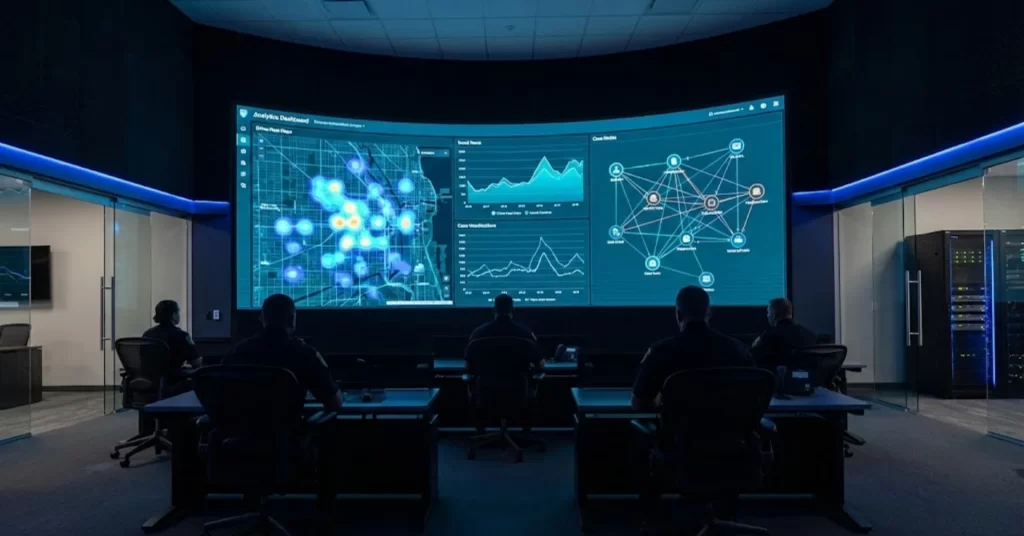
- Artificial intelligence will be a great help in pattern recognition and case management by making connections between related incidents in different jurisdictions automatically.
- Inter-Agency data sharing through secure networks will be a big step forward for real-time collaboration between agencies to resolve cases faster than ever.
- Improved mobile capabilities and field reporting tools will empower more officers in the field with full functionality, improving coordination and safety.
- Cloud-native architecture is becoming the industry standard, as they deliver better scalability, cost efficiency, and faster data sharing.
- Advanced analytics and predictive policing tools will provide effective resource allocation of the agencies and improve clearance rate and speed.
- Digital evidence from body cameras and surveillance systems in integrated systems allows the centralization and better quality of all investigative materials.
- Blockchain technology in evidence management and chain of custodyenables a transparent and secure record of cases and evidence from collection to storage to court.
These trends point toward an environment where highly integrated, cloud-native, and intelligence-driven RMS platforms become the foundation of everyday policing, rather than optional upgrades.
Agencies that start planning and investing now will be better positioned to harness AI, secure data sharing, advanced analytics, and deeply integrated digital evidence, turning future technology shifts into operational advantages instead of disruptive shocks.
Frequently Asked Questions
Q: What is the difference between an RMS and an integrated RMS?
A: A regular records management software (RMS) operates independently to deal with incident reports, paper forms, and simple data entry.
An integrated law enforcement records management system combines access to criminal justice databases (NCIC, NLETS), dispatch systems, evidence management, and case files using one platform. Integration removes the hassle of switching across disparate systems.
Q: How does PsPortals integrate with NCIC and NLETS?
A: The Portal XL of PsPortals provides access to NCIC and NLETS systems directly with real-time validation and automated code checking. Officers make queries to criminal justice data through the PsPortals interface only. The outputs appear immediately, along with total audit logging for compliance.
Q: Is cloud-based RMS CJIS compliant?
A: Yes. A cloud-based RMS that is appropriately designed complies with all the standards of the CJIS Security Policy. PsPortals has a cloud-based platform that consists of extensive audit trails, access controls based on user roles, and encryption that is in accordance with the requirements set by the FBI CJIS Division. In fact, cloud deployment eases the management of compliance.
Q: What are the cost benefits of integrated RMS versus multiple standalone systems?
A: Agencies get rid of the contracts with several vendors, merge the support arrangements, cut down the different platforms’ training needs, and do away with the maintenance of on-premise hardware. The implementation timelines are significantly shortened.
Q: How long does it take to implement an integrated RMS?
A: The zero-footprint browser-based platforms, such as PsPortals, have a faster deployment than on-premise solutions. A primary installation requires 4-8 weeks for small agencies, 8-12 weeks for bigger departments. Gradual rollouts lengthen the schedules but lessen the disruption of operations.
Q: Can integrated RMS support multi-jurisdictional data sharing?
A: Yes. The agencies accessing data through NLETS and N-DEx connections have both regional and national systems at their disposal. The capability of Multi-jurisdictional data sharing enables a simultaneous querying of the shared databases by multiple agencies. PsPortals’ Super Administrator tools control the permissions across all departments.
Choosing the Right Integrated Records Management Solution
Today’s law system requires an integrated law enforcement records management system with interconnected data systems for incident reporting, case management, evidence tracking, and criminal justice databases.
The right integrated RMS increases productivity, reduces cost, speeds up investigations, and improves officer safety. It also gets rid of compliance risks that arise from inefficiently linked systems.
In turn, these benefits translate to better public security, higher clearance rates, and stronger confidence in law enforcement agencies.
PsPortals is the optimal choice for law enforcement agencies looking for:
- Seamless NCIC/NLETS integration through Portal XL
- Zero-footprint deployment for rapid implementation
- Built-in CJIS compliance for regulatory relief
- 30 years of reliable service to law enforcement agencies
- A cost-effective cloud-based RMS architecture
- Criminal justice specialists’ support at any time
Get in touch with PsPortals today to discuss your integrated RMS needs. Schedule a free demo and see how Portal XL can transform your agency’s records management.