
The Hartford Police Department saw a 442% increase in case solvability for firearm assault when they implemented video analytics into their command center. This shows the impact of a Real-Time Crime Center (RTCC) that provides live data and intelligence to officers on the field.
Today, police departments need to make decisions based on data to improve awareness, response times, and officer safety. Real-time crime analytics tools help by turning raw data into useful information officers can act on.
This guide covers what real-time crime analysis tools do, their main features, and how they integrate with existing systems. You’ll also learn why agencies of all sizes are using analytics to prevent and investigate crime.
The first step is to define what “real-time crime analytics” really means.
What are Real-Time Crime Analytics Tools?
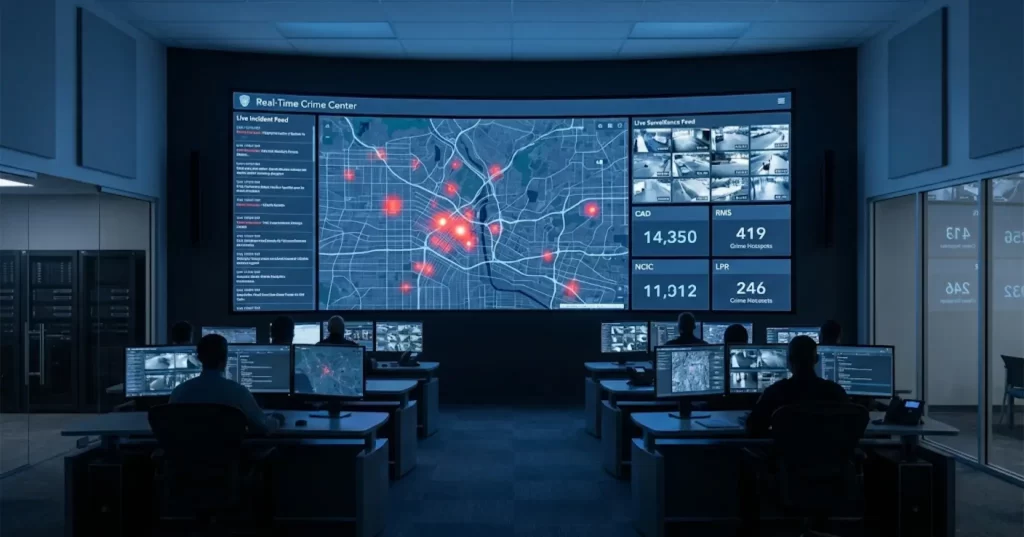
Real-time crime analytics tools are softwares that collect, process, and analyze criminal justice data. It serves as the foundation for all RTCC, providing police departments with immediate, actionable intelligence.
These systems integrate information from multiple sources. They include crime reports, computer-aided dispatching (CAD) systems, surveillance cameras, license plate readers (LPR), records management Systems (RMS), and criminal justice databases to identify patterns, predict crime hot spots, and support investigations as events unfold.
The core components of real-time crime analytics tools include:
- Data Integration: Access and pull necessary law enforcement data from CAD, RMS, NCIC/NLETS, video feeds, and sensors.
- Analytics Engine: Multi-layered analytics and predictive capabilities provided by artificial intelligence and machine learning.
- Visualization: To provide users with relevant data about the area where the crime occurred using maps, dashboards, heat maps, and timelines.
- Real-Time Processing: Processes and shares all incoming information immediately.
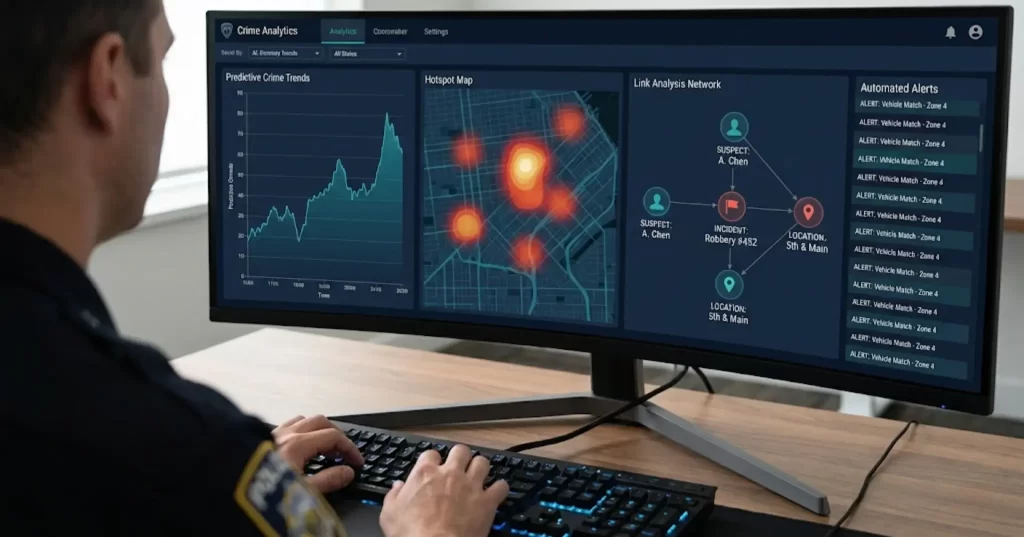
- Alert Systems: Using pre-determined triggers allows the system to automatically notify local police departments of pattern matches or thresholds.
These components work hand in hand to give real-time police crime analytics tools the capabilities they need to meet modern policing demands.
Core Capabilities of Modern Crime Analytics Platform
Modern police crime analytics platforms offer advanced strategic insights for law enforcement, from reactive data viewing to a proactive approach. This guides actions that can prevent or resolve crimes.
Predictive Analytics and Hot Spot Mapping
The use of machine learning algorithms enables police departments to predict crimes. Hotspot mapping directs and optimizes the allocation of personnel and resources to high-crime areas by utilizing historical data.
Pattern Recognition and Link Analysis
Advanced crime analysis tools identify hidden connections between seemingly unrelated incidents. Link analysis does this by checking the Modus Operandi (M.O.), common suspects, cluster locations, and temporal patterns to reveal connection maps and highlight complex networks and organized crime operations.
Geospatial Analysis and Crime Mapping
GIS technology overlays crime data on interactive maps to give a spatial point of view for defining patrol boundaries. It also visually analyzes the evolution of crime patterns over time (temporal animation).
Real-Time Video Analytics
By connecting surveillance cameras to video management systems, AI can identify items, people, behaviours, vehicles, and property. Advanced video searching capabilities allow the investigation of specific people, vehicles, or events across hours of footage to be completed within minutes.
Automated License Plate Recognition (ALPR)
This instantly checks captured plates against wanted suspects and/or stolen vehicles. It provides real-time alerts for officer intervention after identifying vehicles that are “hot” or stolen.
Data Fusion & Integration
The most powerful law enforcement analytics software unify disparate data sources, including 911 calls, officer reports, jail records, court data, social media, and criminal justice databases into a single analytical environment. This allows a holistic view, which is imperative to creating a complete report of events that transpired.
AI-Powered Insights
The application of AI to create leads and evaluate urgency allows law enforcement investigators to be more effective. AI can analyze a case and recommend the next steps for an investigation based on the types of patterns within successfully solved cases.
The Critical Role of Database Access in Crime Analytics
Real-time crime analytics are only as powerful as the data feeding them. The foundation of effective analysis is secure, immediate access to criminal justice databases.
Traditional methods create bottlenecks, hindering the data flow required from NCIC (wants, warrants), NLETS (interstate queries), State Criminal History Repositories, and Local RMS systems (incident reports).
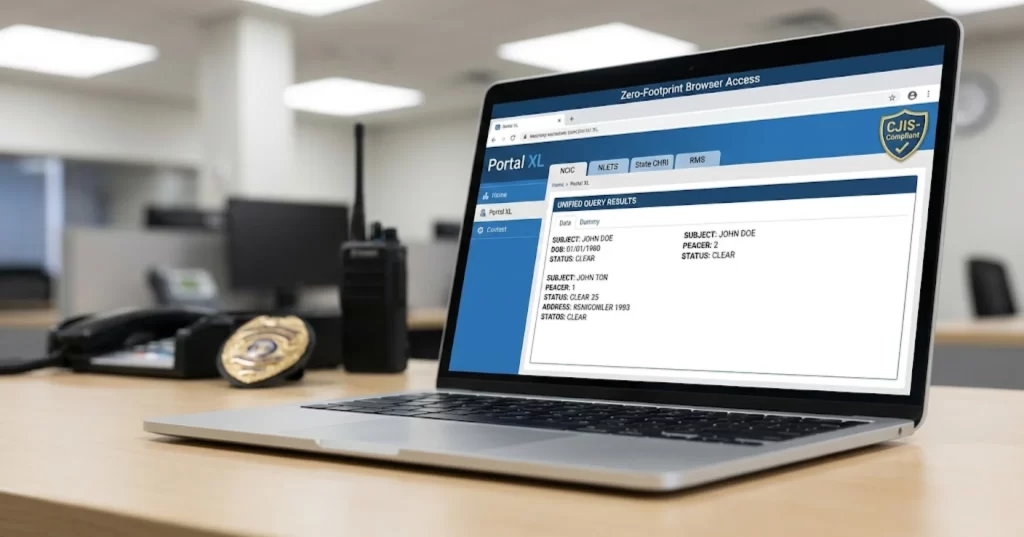
PS Portals’ Portal XL serves as a critical data bridge for Real-Time Crime Center (RTCC) operations. It’s a zero-footprint, browser-based system that makes it easy for you to securely access crucial information.
Here’s how Portal XL supports RTCC operations:
- Instantaneous NCIC/NLETS Queries: Access federal and State data instantly through one platform while you continue to work with your analytics tool, allowing for quick responses to live investigation questions.
- CJIS-Compliant Architecture: Security measures, two-factor authentication, and detailed auditing trail features combined provide a solution for agencies to comply with all federal regulations and protect their sensitive information.
- Automated Data Validation: Checks your data before submission so only accurate and standardized data arrives at your analytics tool.
- Continuous Operations: The zero-footprint structure allows your agency to process requests 24/7 without compromising the scale or the amount of installation and maintenance needed.
Types of Real-Time Crime Analytics Tools
There are various types of real-time crime analytics tools. Each one represents different integrations and specialties that offer comprehensive and data-driven intelligence for RTCC.
Centralized RTCC Platforms
These are all-in-one solutions, such as Axon Fusus, that serve as centralized hubs. It combines video management, data integration, analytics, and case management into a single cloud environment.
Specialized Crime Analysis Software
This type is designed to support deeper analysis of crime trends, making use of advanced crime analysis tools to probe historical crime data and develop predictive crime modeling and crime pattern recognition.
Video Analytics & VMS Solutions
Platforms like Milestone XProtect and BriefCam (Video Analytics) allow analysis of video evidence. It can search for specific factors like objects, persons, and behaviors during the video review, and then connect them with other crime data based on possibly related findings.
Geospatial Intelligence Platforms
These include geospatial data-based tools like ESRI’s ArcGIS that deliver advanced mapping, spatial analysis, and geographic profiling. They help visualize patterns and locations for emergency response and crime investigations.
Predictive Policing Software
Allows AI-driven forecasting of the potential likelihood of crime within an area, which dynamically optimizes patrol routes.
Decision Intelligence Platforms
Products such as Cognyte NEXYTE have advanced and integrated AI and fusion technologies to join differing data sources and ultimately fast-track the investigative process by revealing sophisticated and complex correlations in all data.
The Integration Imperative
No single tool does everything. Successful RTCCs combine specialized tools into integrated ecosystems. Portal XL serves as the database access foundation that feeds data to these analytical platforms.
Key Benefits of Real-Time Crime Analytics
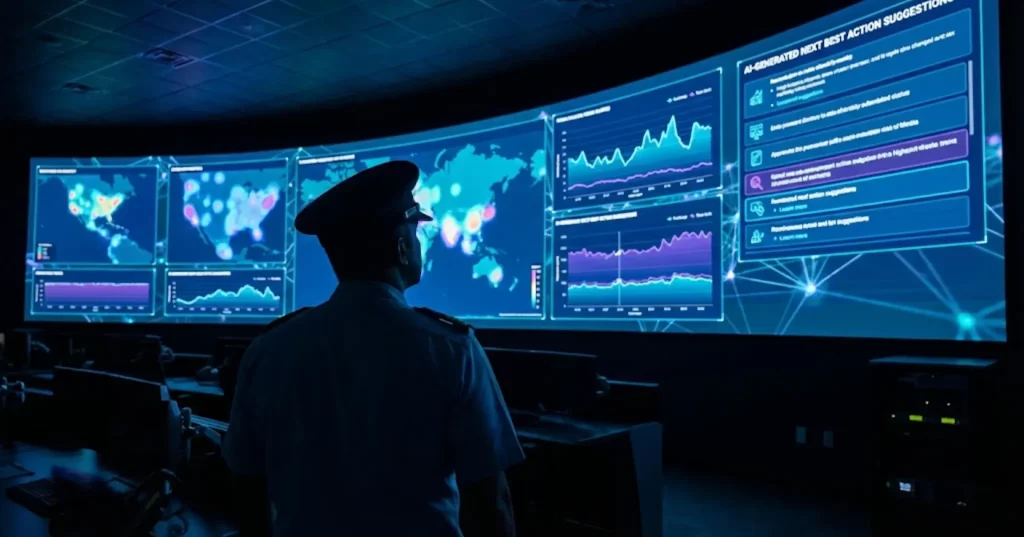
Real-time crime analytics transforms law enforcement from a reactive force to a proactive entity, delivering tangible benefits across operations and community relations.
- Preventive Crime Prevention: Predictive analytics and machine learning provide the opportunity to forecast crime trends in “high-risk” areas and times. By doing this, police departments can deploy resources before crimes occur.
- Faster Investigations: Automated pattern recognition and link analysis provide tools to identify the connection between cases quickly. This reduces the time spent on manual review, giving more focus on the “big picture” of a case. In Hartford, with the introduction of video evidence, there was a 442% increase in solvability for firearm assaults.
- Efficient Use of Resources: Through analytics, the chief and command staff have a better view of how to use available personnel in “at-risk” neighborhoods, allowing for more effective patrol shifts.
- Enhanced Officer Safety: RTCCs provide “digital backup” by instantly relaying actionable intelligence on suspect history, warrants, and location patterns. This enriches situational awareness and keeps officers away from danger.
- Measurable Outcomes: By utilizing analytical metrics to track overall crime reduction and continuous increase in clearance rates, police can track progress efficiently.
- Building Community Trust: By using transparent and open access to information, police departments create trust and accountability amongst the public.
Implementation Considerations for Police Departments
Real-time crime analytics can be effectively implemented through a plan focused on mission objectives, compliance with regulations, and sustainability.
- Identify Purpose: Agencies must begin by identifying the specific purpose or mission of their agency regarding the success of RTCC. Identifying measurable objectives provides the basis for deciding what to implement within the agency and how to measure success.
- Evaluate Data Infrastructure: Evaluate quality and availability of current data infrastructure that provides secure access to a unified database that enables the agency to apply police crime analytics to its data.
- Plan for Integration: Agencies must plan for the integration of law enforcement analytics software into current systems, such as CAD, RMS, and video management systems, so that these tools work seamlessly together.
- Verify CJIS Compliance: CJIS-compliant platforms that access criminal justice data must meet the requirements of strict CJIS Security Policy Standards, including strong security controls and audit trails.
- Consider Agency Size and Budget: Agencies can implement a “crawl, walk, run” strategy for scaling up the use of RTCC technologies. Agencies should budget for ongoing operational expenses and should explore the use of cloud-based solutions to reduce long-term overhead expenses.
- Provide Custom Training: Providing customized training for agency staff on how to best utilize RTCC technology is essential to maximize operational efficiencies and returns on investment.
- Community Trust: In order to gain support and avoid backlash regarding the use of sensitive technologies, agencies must be transparent in their data usage and provide a detailed Privacy Policy.
- Use of Grants: Agencies should look to federal and state grant programs (e.g., COPS Grant Programs) that provide funding to support the initial acquisition and deployment of RTCC technology.
The Future of Crime Analytics Technology
The future of crime analytics is defined by the convergence of advanced technologies focused on deeper proactivity and accessibility.
- Advanced AI: Utilization of Natural Language Processing (NLP) to analyze unstructured reports and Computer Vision for automatic suspect/object identification.
- 5G and Edge Computing: Enables faster data transmission and in-field analytics processing to reduce network load.
- Federated Analytics and Augmented Reality: Facilitates secure cross-jurisdictional data sharing and overlaying analytical insights onto officer field-of-view displays.
- Blockchain: Secures the evidence’s chain of custody and audit trails for compliance.
Regardless of these advancements, the constant requirement remains: fast, secure, and compliant access to criminal justice databases. Platforms like PortalXL will continue to provide the foundational data infrastructure and secure access to NCIC/NLETS networks necessary to power these next-generation analytical tools.
Frequently Asked Questions
Q1: How does crime analysis differ from Real-Time Crime Analytics?
Crime analysis utilizes historical data to highlight trends and patterns associated with crime to make long-term plans. Real-time Crime Analytics uses real-time data feeds to generate real-time intelligence that is acted upon quickly and utilized for further investigation.
Q2: Should small police departments use Crime Analytics Tools?
Yes, Crime Analytics Tools are scalable to fit small police department needs. Smaller police departments can implement a focused cloud solution using a Crawl, Walk, Run strategy in order to use their limited personnel and budget efficiently over time.
Q3: What is the method Crime Analytics Tools use to access Criminal Justice Databases?
Crime Analytics Tools access databases through a secure, compliant data bridge, such as “Portal XL,”. This unifies disparate criminal justice system resources into one user-friendly and secure interface for unlimited real-time querying.
Q4: What are the costs associated with Real-Time Crime Analytics?
Cost can vary depending on the number of integrations, scale, and features required. This includes the ongoing costs associated with their software license, computer hardware maintenance, and training, as well as possible grant funding in their annual budgets.
Q5: Are crime analytic tools required by the CJIS Security Policy to comply with the standards outlined within?
In order to access sensitive Criminal Justice Information, crime analytic tools and police departments must comply with CJIS Security Policy requirements.
Choosing the Right Analytics Tools
Law enforcement analytics software have become an invaluable resource to police departments. It proactively prevents crime, conducts investigations faster, and allocates resources more effectively. Successful implementations include both specialized crime analytics platforms combined with an extensive data infrastructure.
PsPortals Portal XL greatly enhances the real-time crime analytics of police departments, as it offers a safe and secure method to connect and obtain validated real-time data from NCIC, NLETS, and state criminal justice databases. Using zero-footprint architecture provides organizations with high-grade security and compliance.
Contact PsPortals to find out how Portal XL can benefit your agency’s Real-Time Crime Analytics.