

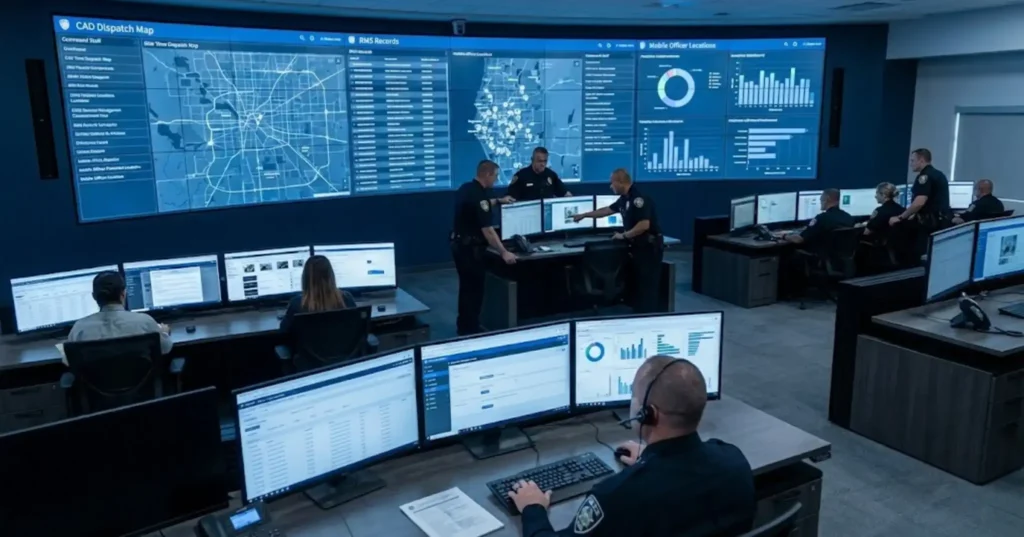
Modern policing is more dependent on law enforcement software than at any point in history. Agencies are pressured to modernize operations across the country. Aside from that, modernizing operations, meeting the escalating compliance requirements, and improving transparency with limited budgets are significant pressures for them as well. But many police departments still rely on legacy systems, disconnected platforms, or out-of-date processes that slow down the officers and increase risk.
Agencies today consider the right police department software as no longer just about buying a single tool, but about building an integrated ecosystem. Each technology must work together seamlessly while meeting the strict CJIS (Criminal Justice Information Services) security standards, from police station software and records systems to mobile access and analytics.
This guide is designed to assist police chiefs, IT directors, procurement officers, and command staff in making an informed decision about law enforcement software solutions. It breaks down the major software categories. This guide also includes an explanation on how to evaluate vendors and, most importantly, shows why a secure database access infrastructure is a kind of foundation that allows every system to work.
By reading from the introduction to the conclusion part, you’ll understand how to approach technology investments strategically, lessen long-term costs, improve officer safety, and build a software stack that’s ready for the future, supporting effective and compliant policing.
Why Law Enforcement Software Matters for Modern Police Departments
The continuous growth of demands placed on police departments does not correlate with the still-constrained budgets and staffing. Law enforcement software that’s built with purpose responds to these challenges through streamlining operations and reducing unnecessary administrative work.
One of the most immediate benefits is operational efficiency. Automated workflows eliminate duplicate data entry, streamline report writing, and simplify evidence handling. Through this, law enforcement officers will spend their time less behind desks and more time on patrol or engaged in the community.
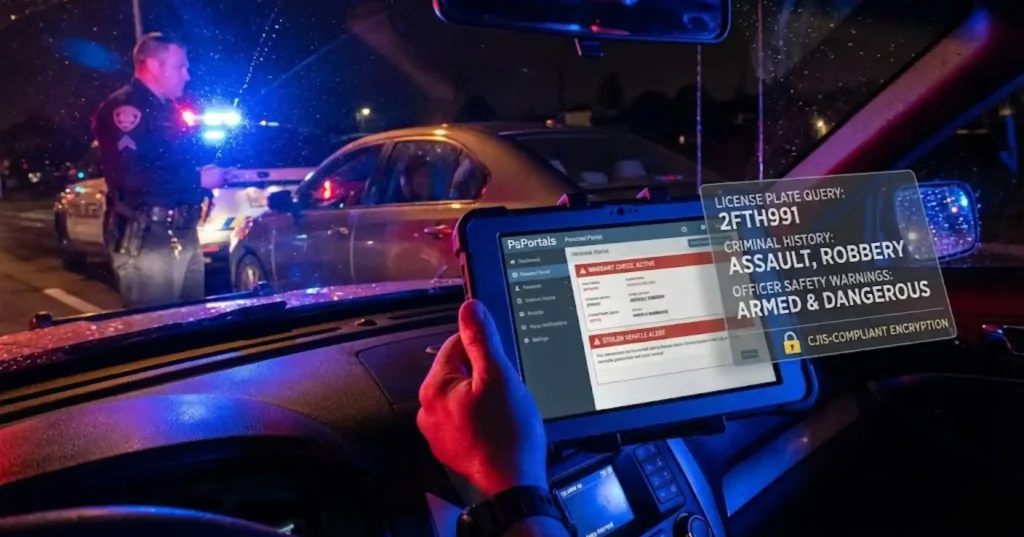
Another critical factor is officer safety. In order for the officers to make an informed decision during encounters (traffic stops, calls for service, and field encounters), they need access to real-time criminal histories, wants and warrants, and stolen property alerts. Database access from the field before an approach ensures officers know what they’re facing.
CJIS compliance is non-negotiable. In terms of protecting sensitive data, preventing unauthorized access, and supporting compliance audits, specialized law enforcement computer software includes built-in safeguards. Specifically, encryption, audit logging, and access controls meet federal security requirements for criminal justice data.
Departments use data-driven decision-making. Leaders can share resources based on useful evidence rather than assumptions through analytics tools. Analytics tools are used to uncover crime trends, gaps in deployment, and staffing needs.
Modern police station software not only supports community trust but also enhances it. Public confidence in law enforcement operations is enhanced through accurate records, transparent processes, and accountable systems, such as body cameras and reporting platforms.
Types of Law Enforcement Software for Police Departments
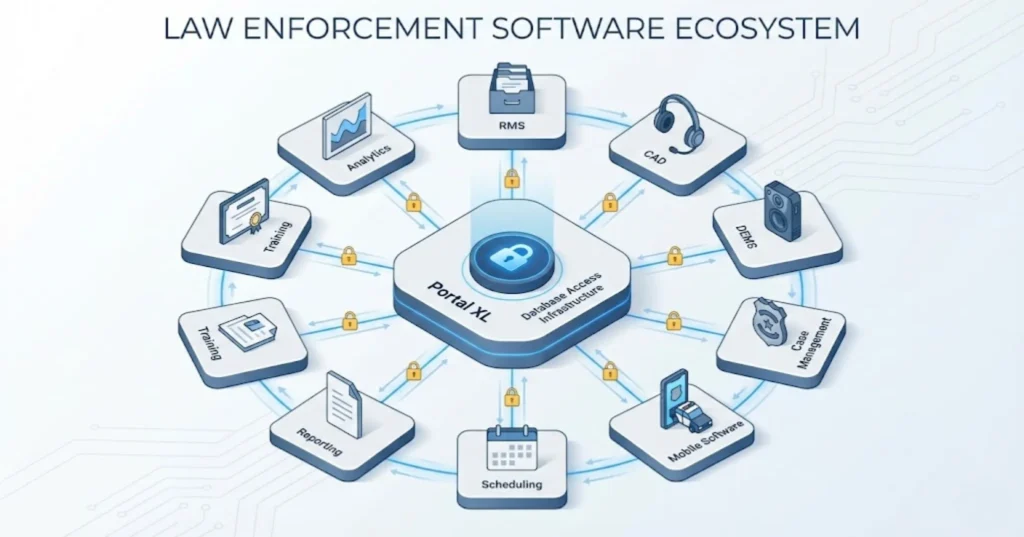
Modern agencies rely on a wide range of software categories, each designed to address specific needs during operations. It is important to understand these tools when you are either building a technology stack or upgrading it.
1. Records Management Systems (RMS for Police Departments)
These systems serve as the main repository for reports regarding incidents, arrests, citations, and the documentation of the case. RMS platforms exist to serve as the single source of truth for departmental records and often integrate with CAD, evidence management, and database access platforms. Examples of these systems include Spillman, CivicRMS, Matrix, and Mark 43.
2. Computer-Aided Dispatch (CAD) Systems
911 calls are managed by CAD systems from intake through resolution. They support the handling of the calls, unit recommendations, resource tracking, and incident creation. CAD systems and RMS both depend on real-time database access for warrant checks and criminal history queries. Hexagon, Motorola PremierOne, and 10-8 Systems are the common solutions.
3. Digital Evidence Management Systems (DEMS)
Body camera footage, crime scene photos, videos, and audio recordings are securely stored by DEMS platforms. The functions of DEMS are to maintain the chain of custody, automate retention schedules, and facilitate the sharing of evidence with prosecutors. They widely use cloud-based options like Axon Evidence, NICE Investigate, and FileOnQ SAFE.
4. Case Management and Investigation Software
Case management software is reliable in terms of organizing investigative workflows, tracking leads, interview management, and connecting related cases. These platforms often utilize analytics to identify patterns across investigations, including reliance on database access for criminal history and warrant queries. Some of the examples are Kaseware, Column, and CrimeSoft.
5. Mobile Police Software for Field Operations
Mobile police software reduces radio traffic and speeds up field decision-making, considering the fact that it allows officers to file reports, access databases, and query information directly from patrol vehicles or smartphones. Secure, CJIS-compliant mobile access to NCIC and NLETS is essential. Solutions include PsPortals Personal Portal and MDT platforms.
6. Police Scheduling Software and Workforce Management
Scheduling software is conducive to reducing administrative workload and improving transparency for supervisors and officers because it automates shift assignments, overtime tracking, and personnel availability. Some of the examples are PowerDetails, Vector Scheduling, and Adashi.
7. Law Enforcement Reporting Software
Reporting platforms are advantageous in simplifying incident documentation and ensuring compliance with NIBRS. They also standardize reports across the departments and combine them with RMS, avoiding duplicate data entry. The examples are Report Executive, eCrash, and Matrix.
8. Training and Compliance Management
Training systems are important in terms of tracking certifications, policy acknowledgements, and continuing education of the officers. They manage NCIC operator certifications and compliance documentation. Examples include PowerDMS, Vector Solutions, and PsPortals Testing & Certification.
9. Crime Analytics and Intelligence Platforms
Data analytics tools identify crime patterns, predict hotspots, and generate investigative leads. For meaningful insights to be delivered, these platforms require access to comprehensive criminal justice databases. The examples included are Beagle and Accurint Virtual Crime Center.
It is important to consider that, although each of these tools serves a specific function, they all rely on one critical layer, and that is secure and compliant access to criminal justice databases.

The Foundation: Database Access Infrastructure for Law Enforcement Software
Every law enforcement solution, from RMS and CAD to case management and mobile applications, depends on access to databases regarding criminal justice. NCIC, NLETS, state repositories, and local systems give the information officers and investigators the tools they need to do their jobs effectively. If there is no present secure, CJIS-compliant database access infrastructure, these systems can’t function at their full potential.
Why Database Access Is Mission-Critical
- Dispatch operations need fast access to warrants, stolen vehicles, and criminal histories to brief responding officers accurately. CAD systems need real-time connectivity to send this intelligence.
- Investigations depend on constant database access in identifying suspects, confirming criminal histories, and revealing connections across jurisdictions.
- Field officers need mobile access during traffic stops, welfare checks, and field interviews without tying up dispatch resources.
- Records management systems ensure the importance of accuracy and the prevention of duplicate records through validating data against authoritative databases.
PsPortals Portal XL: The Database Access Foundation
PsPortals Portal XL is considered a CJIS-compliant database access layer that is relied on by modern law enforcement software ecosystems. These are what Portal XL delivers:
- A combination of NCIC and NLETS access from a single interface
- Zero-footprint security without any local data storage
- Built-in CJIS compliance that includes MFA, encryption, and audit logging
- Perfect combination of CAD, RMS, case management, and mobile tools
- Live validation to prevent query errors
- Whole audit trails for accountability
- 24/7 cloud-based reliability
Supporting Your Entire Law Enforcement Software Ecosystem
When Portal XL becomes part of an agency’s law enforcement software solutions stack, it will serve as the main database access infrastructure that is helpful in systems connecting and working together securely. As CJIS-compliant police software, Portal XL allows each platform to access critical criminal justice data while continuing to meet federal security requirements.
When Portal XL takes place:
- CAD systems can provide real-time warrant and stolen property alerts when there’s a dispatch. These systems give officers early essential intelligence before their arrival.
- Case management platforms can question criminal histories and cross-jurisdictional records throughout investigations, which can lead to improved case development and clearance rates.
- Mobile applications, like PsPortals Personal Portal, extend secure database access directly to field officers without being dependent on dispatch.
- RMS systems can improve the accuracy of the data and reduce either duplicate or inconsistent entries, since these confirm records against national and state databases.
- Training and compliance systems can manage NCIC operator certifications and ensure that only authorized personnel can access criminal justice databases.
Database Access in the Field
The situation is when an officer initiates a traffic stop and enters a license plate into a mobile device using law enforcement software. After that, the query is securely routed through Portal XL, the database access infrastructure of the agency, to the NCIC stolen vehicle database. Just a few seconds later, the system comes back with a result that indicates that the vehicle is stolen and immediately sends an alert to the officer.
There will also be a retrieval of additional warrant information that links with the registered real owner. Every action in the process is logged automatically, making a complete audit trail for the case documentation and, of course, CJIS compliance.
All of these can happen without the officer having the need to call dispatch or leave the patrol vehicle. This is a proof demonstrating how law enforcement computer software, with the support of CJIS-compliant police software like Portal XL, can improve officer safety, operational efficiency, and compliance in real-world situations.
Investment in Infrastructure
Before agencies invest in CAD, RMS, or case management platforms, they should first ensure that they have a strong database access infrastructure in place. Portal XL provides this foundation, allowing specialized software for law enforcement to send maximum value while, at the same time, maintaining strict CJIS compliance.
In simple terms, by establishing secure and reliable access to NCIC and NLETS at the infrastructure level, departments position themselves for smoother integrations, lower long-term costs, and more effective policing.
Best Police Software: How to Choose the Right Solutions
The rise of technology allows agencies or companies to spend money on anything that makes jobs both worker-friendly and company-friendly. Hence, the reason why impulse buying is sometimes unavoidable.
But, similar to a simple and smart consumer’s way of thinking about purchasing goods, considering a lot of things before investing for the sake of convenience is crucial. Choosing only the best among the rest takes time and effort; that’s why thoughtful selection is more effective and safe than impulse buying.
In selecting the best police software, you should:
1. Assess Your Agency’s Needs
Start by assessing what your agency needs. You can do this by identifying workflow bottlenecks, compliance gaps, and operational challenges. You can gather input from patrol, investigations, dispatch, and command staff.
2. Prioritize Integration and Interoperability
Systems that are disconnected can create silos. You need to ensure that new platforms integrate with existing tools. Portal XL should connect seamlessly with CAD, RMS, and mobile solutions.
3. Verify CJIS Compliance
CJIS requirements must be met by any software accessing criminal justice data. You should verify that vendors undergo regular audits and sign appropriate security addenda.
4. Consider Total Cost of Ownership
Look at what’s more beyond licensing fees. You should include implementation, training, support, storage, and future upgrades. Oftentimes, systems that are cloud-based offer more predictable costs.
5. Evaluate Scalability and Vendor Stability
Consider the vendor stability, support quality, and product roadmap. Moving from one system to another can cost a lot of money and can be disruptive if long-term viability is not considered.
6. Involve All Stakeholders in the Decision
Decisions that involve technology should include end-users. These users’ input guarantees that the software fulfills operational requirements and achieves widespread adoption.
7. Pilot Before Full Deployment
You should start with a single unit or division to test workflows, integration, and how usable it is. Consolidate feedback, fix issues, and refine processes to reduce risk, ensure a smoother adoption, and guide training and rollout for the whole department.
Cloud-Based Law Enforcement Systems vs. On-Premise Solutions
Cloud-Based Law Enforcement Systems
When police departments choose between cloud-based and on-premise deployments, they must weigh cost, security, and operational flexibility.
These systems give several advantages, like lower upfront costs, since agencies pay for subscription fees rather than large capital investments. Also, there is no need for on-site servers or dedicated IT infrastructure. Plus, automatic updates and security patches are applied centrally.
These systems can be accessed by officers and staff from anywhere. It supports both operations that require many locations and remote work. Due to how cloud platforms scale easily, agencies can add users or storage as needed without needing additional hardware, and they can also include built-in disaster recovery through redundant data centers.
But continuous subscription fees, reliance on reliable internet connectivity, potential data sovereignty issues, and vendor dependency are considerations that departments must be open about addressing. Also, agencies must ensure that cloud providers are maintaining CJIS compliance for the sensitive criminal justice information to be protected.
On-Premise Police Station Software
This software gives complete control over data and infrastructure without relying on vendor services and a perceived security advantage since data stays local. These solutions usually involve one-time licensing costs, though maintenance, upgrades, and IT staffing can be significant. Additional hardware investments are often required in disaster recovery, backups, and remote access capabilities, which become the agency’s responsibility.
The Trend Toward Cloud
The modern policing trend is clearly toward cloud-based solutions. Famous and leading software for law enforcement, just like Portal XL, Axon Evidence, and Mark43, now primarily operates in the cloud. These platforms are undeniably providers of superior reliability, cost-effectiveness, and operational flexibility when implemented with CJIS-compliant security. These are a strong choice for agencies compared to old and aging on-premise infrastructure.
Mobile Police Software: Extending Capabilities to the Field
The dependence on mobile police software in modern policing is increasing. Its growing usage is unsurprising, since it gives officers the information they need whenever and wherever they need it, which makes their job easier to navigate.
Officers are required to access data, document incidents, and communicate with dispatch without using radio traffic or returning to their station, because seconds matter in the field.
A core capability of an effective mobile solution is secure database access. Officers need live access to NCIC, NLETS, and local databases from patrol vehicles or smartphones. These queries are extended directly to the field through the use of tools, like PsPortals Personal Portal. This is all done while maintaining full CJIS-compliant police software standards that ensure the protection of sensitive data is retained.
Mobile reporting further reduces the administrative responsibilities by letting officers complete incident reports at the scene. The given applications should be combined seamlessly with RMS platforms to remove duplicate entries while improving data accuracy at the same time.
Mobile devices are also used to support evidence collection, allowing officers to take photos of the crime scenes, record statements, and document field contacts. The evidence uploads automatically to digital evidence management systems, allowing the chain of custody to be preserved.
Integration with dispatch is equally critical. Because of mobile data terminals or smartphone apps that are tied to CAD systems, officers can receive assignments, update their status, and improve patrol management software workflows in real time.
Security still remains a top concern. Mobile solutions must use a design that leaves no trace on devices, require multiple forms of identity verification, secure connections, and automatic logouts; this way, if a device is lost or stolen, sensitive criminal justice information stays. Agencies are also required to decide whether to choose BYOD or agency-issued devices, with browser-based platforms like Portal XL that support either option securely.
CJIS-Compliant Police Software: Understanding Compliance Requirements
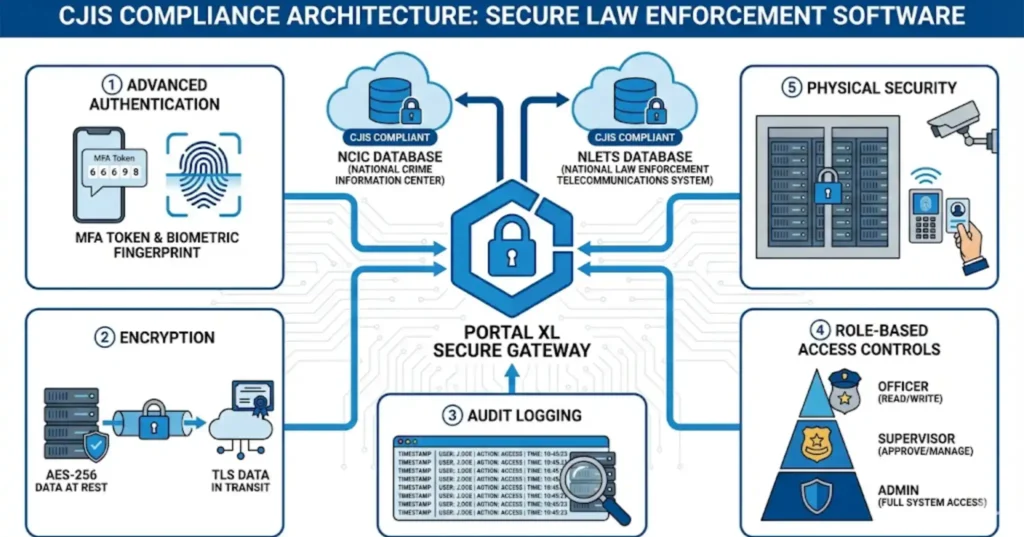
CJIS compliance is not optional for police departments; it is rather essential to daily operations. The Criminal Justice Information Services (CJIS) Security Policy establishes minimum security requirements for accessing FBI criminal justice information. It also includes NCIC, III, and NGI systems. Before having access to this data, any software for law enforcement must meet CJIS standards to protect sensitive information and maintain system access.
In terms of operations, CJIS compliance is an indication that strong safeguards are built directly into CJIS-compliant police software. One of the most critical requirements is having advanced authentication. Multi-factor authentication is required to be used by the staff and officers, not just usernames and passwords, in order to prevent unauthorized access.
Also, encryption is equally important to ensure criminal justice data is protected both during its transmission and while it’s stored.
Another key requirement is audit logging. Systems are required to record who has accessed the data or when it was accessed, including what actions were taken when it was accessed. This creates a complete audit trail for reviews and investigations.
Access controls based on roles ensure users only see the information needed for their duties, following the principle of least privilege. Risks are reduced by physical security and personnel screening through making sure that only authorized, trained individuals can access criminal justice systems.
There are severe consequences for non-compliance, such as the risk of agencies losing access to NCIC. This just means that there are no warrant checks, criminal history lookups, or interstate queries. It is important for agencies to verify that their law enforcement software solutions maintain CJIS compliance and sign the required security addenda.
At its core, PsPortals Portal XL was built with compliance. Portal XL integrates CJIS requirements directly into its architecture instead of retrofitting security features. This helps the agencies to maintain secure, uninterrupted access to critical criminal justice databases.
Integration: Making Your Law Enforcement Software Work Together
The average police department relies on a lot of systems to work well. These systems are CAD, RMS, evidence management, case management, training, scheduling, and analytics. When these law enforcement software solutions work separately, officers lose time by switching platforms, re-entering data, and reconciling information manually. Errors and slow operations will increase if it is poorly integrated.
Systems can share data automatically with effective integration. A CAD incident should make an RMS record without duplicate entry; footage from a body camera should be uploaded directly into evidence management along with the correct case association. The database queries that are performed through Portal XL should populate investigation files in case management systems; at the same time, mobile reports sync to RMS in real time. Training certifications that are managed in testing & certification platforms should directly control database access permissions.
APIs, open data standards, and integration layers that connect specialized tools to share databases enable this level of coordination. Prioritizing software for police departments is what agencies must do, since it supports interoperability more than creating closed, vendor-locked environments.
It is critical to avoid data silos. When the information is stuck in only one system, departments face records that are inconsistent, limited analytics, and irrelevant administrative work that takes a long time to work on. Interoperable systems will ensure data accuracy and operational awareness.
Integration is addressed by PsPortals through an ecosystem approach. Personal Portal, Testing & Certification, and Super Administrator operate together as unified public safety software platforms. They offer shared user management, consistent interfaces, and especially secure database access while CJIS compliance is being maintained.
Budgeting and Funding for Law Enforcement Software
Law enforcement software budgeting needs a clear understanding of both upfront and long-term costs. In software expenses, expect to include the fees for licensing, which are either subscription-based or perpetual, along with the implementation costs that include system configuration, data migration, and staff training. Agencies must also account for consistent support, storage requirements for cloud solutions, and future upgrades. Cloud platforms usually include recurring subscriptions, yet they often reduce big capital expenses and offer more predictable budgeting.
Technology costs for software for police departments can be significantly offset by grant funding. When thinking about common funding sources, these include the COPS Technology Program from the U.S. Department of Justice, Byrne Justice Assistance Grants, state homeland security grants, VOCA funding for victim-related systems, and body camera implementation grants. This aligns technology investments with grant objectives and increases approval potential.
Agencies should focus on measurable return on investment (ROI) to justify investments in the best police software. Lessened administrative workload means:
- It saves the officer time
- Improves case management
- Increases clearance rates
- It optimizes scheduling
- Lowers overtime expenses
- Cloud-based evidence storage reduces the need for physical storage costs
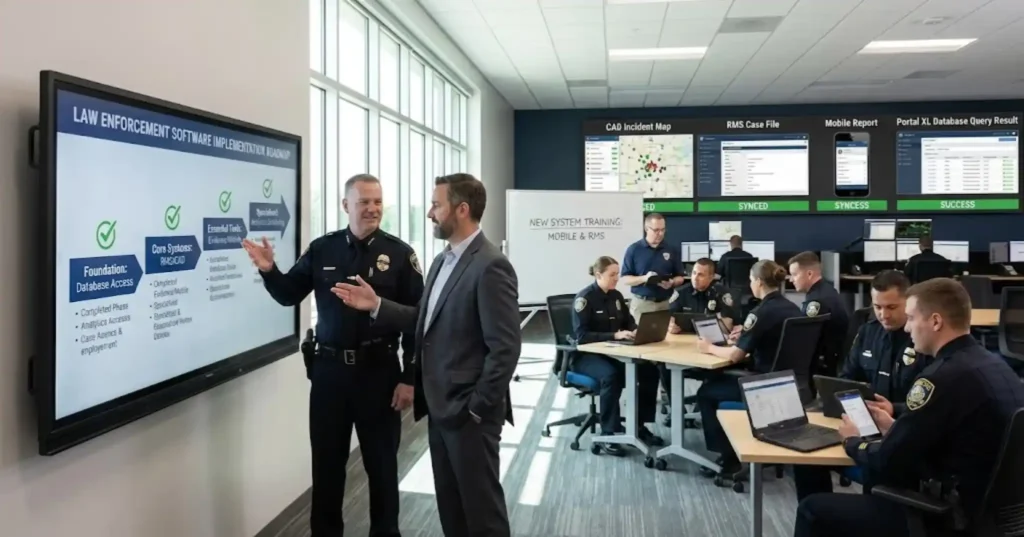
Phased implementation is effective for those agencies with tight budgets. Begin with foundational infrastructure, such as secure database access through Portal XL; next is expanding to RMS integration, mobile tools, evidence management, and analytics as funding follows.
Implementation Best Practices for Police Department Software
Careful planning is needed to succeed in deploying software for police departments. Along with the planning, its success will be achieved with strong leadership and ongoing user support.
Before implementation starts, agencies should document current workflows, identify the pain points, and involve end users in the selection process.
Clear success metrics and a realistic timeline with defined milestones help in keeping the project on track. Identifying champion officers who support adoption can also drive early buy-in.
A mindful data migration strategy is also important. Existing data should be inventoried by agencies, and they should decide whether the transfer of historical records is needed. Agencies should also plan for data cleaning and validation. Maintaining access to legacy systems during transition lessens operational risk, while thorough testing ensures data integrity after migration.
Police station software success and failure are often determined by training and change management. The training should be role-specific, hands-on, and supported by fast reference guides. Super-users can provide peer support, while refresher sessions reinforce skills over time.
A phased rollout reduces disruption. Starting with one unit lets agencies gather feedback, adjust workflows, and demonstrate before expansion. Also, early celebrations for success are helpful in overcoming resistance.
Lastly, momentum is sustained by strong post-implementation support. Regular check-ins, dedicated support contacts, and continuous improvement ensure law enforcement software solutions deliver long-term value.
Frequently Asked Questions About Law Enforcement Software
Q1: What is the most important law enforcement software for police departments?
No single tool fits every agency, but secure database access is foundational. Without reliable NCIC and NLETS connectivity, other law enforcement software cannot function effectively.
Q2: Is cloud-based law enforcement software CJIS compliant?
Yes, cloud-based systems can be CJIS-compliant if the vendor meets CJIS Security Policy requirements.
Q3: How do I know if law enforcement software will integrate with our existing systems?
Verify that the vendor supports APIs, open data standards, and proven integrations with CAD, RMS, and other platforms already in use.
Q4: What is the difference between law enforcement software and police technology?
Law enforcement software refers to operational systems like CAD, RMS, and database access. Police technology, on the other hand, includes hardware, vehicles, and devices.
Q5: How long does it take to implement new law enforcement software?
From a few weeks to several months. It depends on system complexity, data migration needs, and training requirements.
Q6: Do small police departments need the same software as large agencies?
No. Police departments that are smaller benefit from scalable solutions that match their size, budget, and operational needs.
Building Your Law Enforcement Software Stack: Start with the Foundation
When selecting the software for police departments, it is important to remember that you are choosing something that’s relevant for the worker’s convenience and safety; hence, strategic planning is required, avoiding impulse buying. The most effective agencies build their technology stack from the very bottom, starting with secure, CJIS-compliant database access and expanding outward.
Database access infrastructure is at the foundation, such as Portal XL. Core systems like RMS and CAD sit above it, followed by essential tools that include evidence management and access to mobile through Personal Portal. Then come specialized solutions, such as case management, analytics, and scheduling. These are supported by training and compliance systems.
It really matters to start database access because every law enforcement software solution depends on reliable NCIC and NLETS connectivity. Portal XL provides this foundation. This enables seamless integration, stronger security, and long-term scalability.
The next steps are simple. It is crucial to assess your current technological gaps and evaluate database access capabilities. Also consider how Portal XL’s zero-footprint, CJIS-compliant architecture can support your agency.
Contact PsPortals to learn how their integrated platform delivers the best police software foundation for modern policing.