
The Database Ecosystem Behind Every Shift
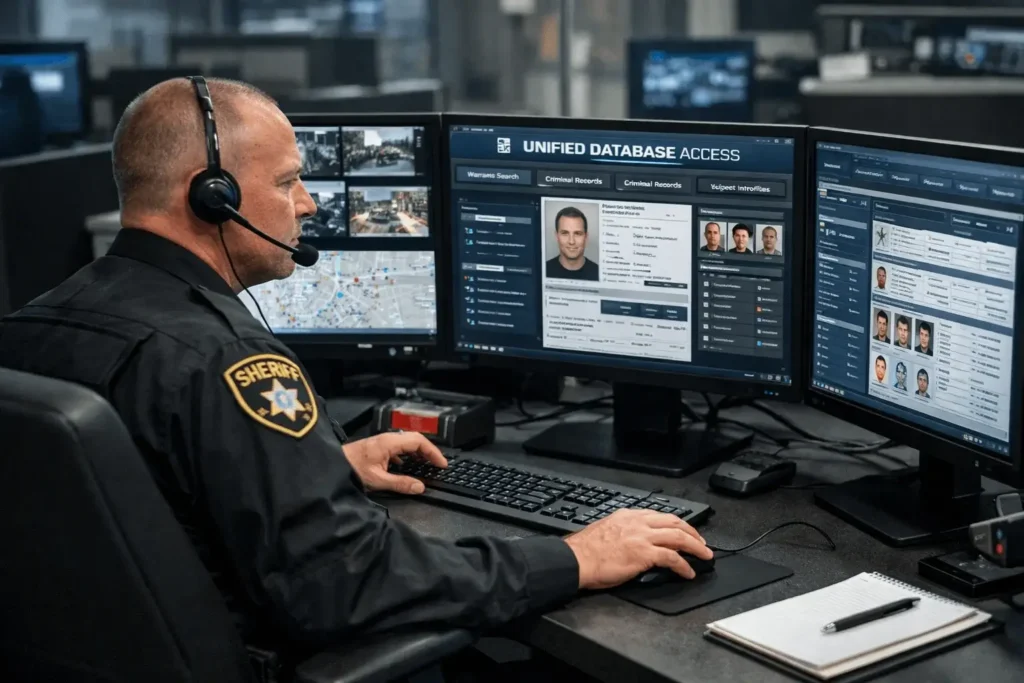
Law Enforcement database access is central to every shift. Whether it’s a traffic stop, a warrant check, or a background investigation, officers rely on multiple systems to build a complete picture of a person or vehicle. No single database holds everything they need.
On any given call, officers interact with a layered ecosystem of databases. NCIC provides access to warrants, stolen property, and missing persons. NLETS supports interstate queries, driver records, and vehicle registration.
State repositories fill in arrest histories and dispositions within a jurisdiction. Local agency databases add jurisdiction-specific records relevant to ongoing investigations.
In practice, criminal justice database access isn’t just one query. It’s often several, across systems that weren’t designed to work as one.
A routine stop may require checking a license through NLETS, confirming warrants through NCIC, and reviewing prior incidents in a local RMS. Investigations go even further, requiring detectives to cross-reference multiple records to understand patterns, associates, and timelines.
Understanding how officers access NCIC and NLETS databases reveals the core issue. Each system operates in its own environment, often with its own interface, credentials, and workflow. The officer or dispatcher has to navigate between them all while handling potentially risky incidents.
This fragmented law enforcement database access shapes how work gets done every day, and not always in ways that support speed or clarity.

What Fragmented Access Actually Looks Like on the Ground
For many agencies, database access still depends on a mix of legacy tools, terminal emulators, and dispatcher workflows. On paper, everything is connected. In practice, the experience is often disjointed.
Officers in the field frequently rely on dispatchers to run queries. Without direct Law Enforcement database access, every query adds delay. Instead of directly accessing a criminal records database for officers, they key the radio and wait. During high-volume periods, this creates delays. Dispatchers must prioritize calls, and database requests compete with everything else.
Dispatchers, in turn, carry a heavy operational load. They move between systems, re-enter data, and interpret results in real time. During shift changes or peak hours, even routine queries can stack up.
From an IT perspective, the situation is just as complex. Teams maintain multiple applications tied to police database query software, each with its own configuration, update cycle, and authentication requirements.
Supporting criminal records databases police rely on often means managing several layers of infrastructure that do not naturally integrate.
The friction shows up in small but constant ways:
- Officers repeat information over the radio that could be entered once.
- Dispatchers retype queries across different systems.
- Errors occur when data is entered multiple times.
- Detectives switch between windows to piece together a subject profile.
- IT staff troubleshoot multiple points of failure instead of one system.
This is the reality of fragmented criminal justice database access in law enforcement. Although it technically works, this series of small inefficiencies can add up across every shift.
Even with simple things like a vehicle check can involve multiple steps, multiple systems, and multiple people. Over time, this slows investigations, increases workload, and adds unnecessary pressure to both field and support roles.
What Changes When Access Is Unified
Now consider a different model. One browser interface. One login. One place to query NCIC, NLETS, state repositories, and local systems at the same time.
This is what unified law enforcement database access provides to every role in the agency.
For patrol officers, the impact is immediate. Instead of calling dispatch, they can run queries directly from a mobile terminal or secure device. A license plate check, warrant search, and background lookup can happen from the same screen. This means faster database access for patrol officers responding to high-risk incidents.
For dispatchers, the change is just as significant. If there are fewer routine query requests, it mostly means more capacity for coordination, officer safety monitoring, and high-priority calls. The role then shifts from mere data relay to operational command with more comprehensive data for every query.
For detectives, unified access means seeing results in one place, even if they’re from multiple systems. Instead of having to toggle between windows, they can now review consolidated data, compare records, and build timelines without breaking focus. A unified criminal justice database platform supports the way investigations actually unfold.
For IT teams, the benefits are structural. A browser-based approach reduces the need for local installations and terminal emulators. Managing access becomes simpler when authentication and permissions are centralized. Supporting browser-based NCIC access no longer requires maintaining multiple endpoints.
Consider a common scenario when an officer is conducting a traffic stop. The driver appears nervous, and the vehicle registration doesn’t quite add up.
In a fragmented system, the officer has to call dispatch, wait for results, and ask follow-up questions. At any moment, the traffic stop can escalate while dispatch is still combing through different systems.
With unified access, the officer or the dispatcher runs the query directly. Results from the NCIC, NLETS, and state records are returned together. The officer sees relevant alerts, prior records, and vehicle information in one view.
Essentially, unified access reduces query time for law enforcement agencies to make the interval between suspicion and clarity shorter.
The Compliance Advantage of Centralized Access
Beyond speed and usability, unified access also supports compliance, which is just as important.
CJIS requirements need accurate and comprehensive audit trails. Every query, login, and user action must be part of the record. This data is spread across multiple systems when the environment is fragmented, so reconstructing activity during an audit can be time-consuming.
Centralized law enforcement database access makes compliance far more convenient. When all queries flow through one system, audit logging becomes consistent and automatic. User activity, timestamps, and query details are captured in one place.
Additionally, role-based access controls are easier to enforce when permissions are managed centrally. Multi-factor authentication can be applied across the platform instead of being configured separately for each system.
With CJIS-compliant, browser-based software solutions, agencies can better align operational workflows with the compliance requirements without the added layers of complexity that come with a fragmented system.
Instead of chasing logs across systems, IT teams can better produce a complete audit trail from a single interface. That clarity reduces the risk and supports accountability across the agency.
What Agencies Should Look For in a Database Access Platform
For agencies evaluating options, the goal is not just faster queries. It is a better operational experience across all roles.
A reliable law enforcement database access platform must have:
- Browser-based deployment that has no local client requirements
- Consolidated access to the NCIC, NLETS, state, and local systems
- A centralized audit logging for CJIS compliance
- Role-based access controls as well as multi-factor authentication
- In-vehicle and workstation browser access for field officers
- Reliable and accessible vendor support at all hours
It should also be able to support the way agencies already work. You don’t want to completely overhaul your workflows just because you switched systems.
This is where platforms like Portal XL from PsPortals come into the conversation. As a law enforcement data access platform, it brings multiple systems into a single browser interface, supporting both operational efficiency and compliance needs without adding infrastructure overhead.
Many agencies are already familiar with the challenges of fragmented systems in every query, every call, and every investigation. The times have changed and modern policing now demands speed and accuracy more than ever.
Frequently Asked Questions
What databases do law enforcement officers access during a routine traffic stop?
In usual cases, officers query NCIC for warrants, stolen vehicle records, and missing persons. They also check NLETS for out-of-state driver records and vehicle registration, along with state criminal history repositories for in-state arrest and disposition data.
Why do law enforcement agencies need unified database access?
Criminal justice data is spread across federal, state, and local systems that do not share a single interface. Unified access lets officers, dispatchers, and investigators query all of these systems from one screen, reducing manual re-entry, lowering query errors, and improving response times.
How does browser-based database access improve CJIS compliance?
A browser-based platform brings audit logs, role-based access, and multi-factor authentication into one place. Every query, action, and login is tracked automatically, making CJIS audits far simpler than piecing things together across disconnected systems.
Can officers access NCIC and NLETS from the field without going through dispatch?
Yes, with a browser-based database access platform, officers can run NCIC and NLETS queries directly from mobile devices or in-car terminals. This reduces radio traffic, frees up dispatchers for higher-priority calls, and gives officers faster access to critical intelligence during field encounters.
What should agencies look for when evaluating a law enforcement database access platform?
Agencies should look for a law enforcement data access platform with zero-footprint browser deployment, consolidated access to NCIC, NLETS, state, and local databases from one interface, and built-in CJIS-compliant security. Zero-footprint deployment, mobile access for patrol officers, and 24/7 technical support are also equally critical.