

Law enforcement relies on fast and accurate criminal justice database access to make critical decisions in real time. Yet in many agencies, something as routine as a background check still means jumping between several different systems.
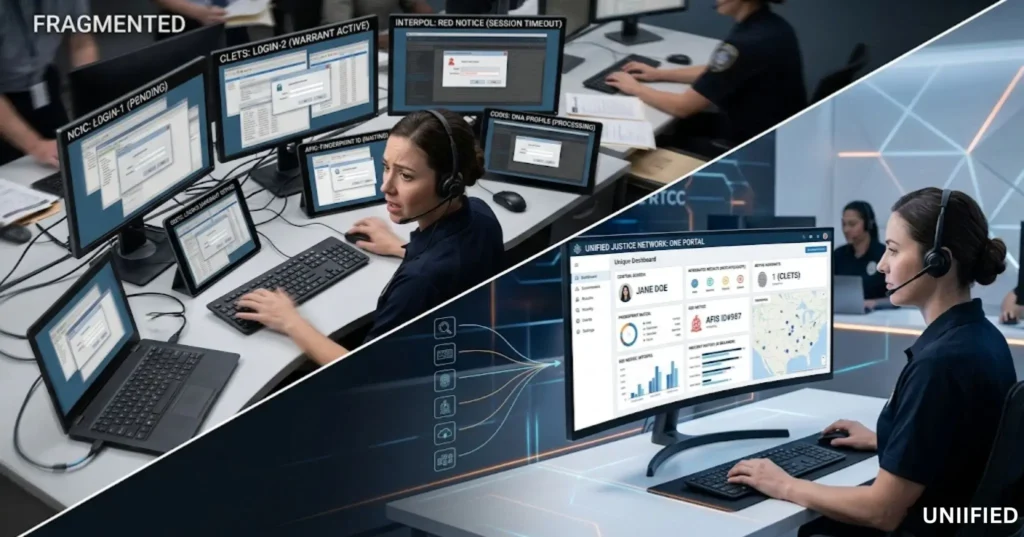
Picture a patrol officer during a traffic stop, switching between an NCIC terminal, a state repository, a local records system, and an Nlets interface. Each query requires a different screen, a different format, and valuable time.
This fragmented approach slows down response times, increases the chance of missing critical information, and creates unnecessary complexity in high-pressure situations.
Unified Criminal Justice Database access solve this problem by consolidating access to federal, state, and local databases into a single interface.
This article breaks down the criminal justice database ecosystem, why there are multiple databases, and how fragmented systems impact daily operations.
The Criminal Justice Database Ecosystem Explained
The criminal justice information ecosystem operates across three interconnected layers. Every layer serves a specific purpose and contains its unique data that no single system can fully replace. Understanding this structure is essential for a deeper look at the specific databases police rely on. See our guide to the criminal justice database ecosystem to understand why unified access matters.
Federal Level Databases
Systems such as the National Crime Information Center, the Interstate Identification Index, and the FBI CJIS Division platforms provide nationwide data at the federal level.
NCIC stores records about warrants, stolen property, and missing persons. Maintaining NCIC compliance and security is a requirement for every agency accessing these records Arial, as well as protection orders. It acts as a centralized index for time-sensitive alerts that officers must access quickly.
Often referred to as Triple I, the Interstate Identification Index focuses on criminal history records. This allows agencies to request rap sheets across state lines, which provides a deeper background information than NCIC alone.
FBI CJIS systems also include biometric and identity services. These systems support fingerprint matching and identity verification, which are critical for confirming subject identities during investigations.
Each federal system has a distinct role, and together, they function as the backbone of national criminal justice data.
Interstate Network Layer
Between federal and state systems sits the interstate communication layer. Nlets is less of a database and more of a law enforcement message switch that routes messages between states.
It doesn’t store everything itself. Instead, it makes sure a query from one state lands in the right place in another, and that the response comes back securely.
Whether it’s a vehicle registration check, a driver’s license lookup, or an admin message, Nlets handles the back-and-forth.
The message switching is responsible for the routing, formatting, and delivery without requiring officers to navigate each state system manually.
This seamless exchange is what allows agencies to work across state lines, which, in today’s fast-paced policing environment, is essential.
State and Local Database Systems
The most detailed and frequently updated information is provided by the state and local systems. These include state criminal history repositories, regional networks, and municipal records management systems.
The official criminal history records including arrests, charges, and dispositions that may not appear in federal systems are altogether maintained by state repositories.
Including gang data or investigative notes, regional networks are responsible for allowing agencies within a state or region to share intelligence.
Together, these three systems create a layered environment where data is distributed rather than centralized. Agencies must access all three layers to build a complete picture.
Why Law Enforcement Needs Multiple Database Access
No Universal Criminal Records Database Exists
There’s no single system that contains all criminal justice data. Each database serves a specific jurisdiction and purpose.
Federal systems provide national alerts and identifiers. State systems offer detailed criminal histories. Local systems capture real-time intelligence and incident data.
These systems often overlap, but they are not identical. An active warrant may appear in one system but not another. Similarly, a local intelligence note may never reach federal databases.
Because of this structure, multiple database access in law enforcement is not optional. It is required for thorough and accurate information gathering.
The Problem with Fragmented Access
The challenge isn’t the number of systems. It’s how officers access them.
In many agencies, officers must query multiple systems separately during a background check. Each system requires a different login, interface, and query format.
This manual switching creates delays. Officers and dispatchers conducting comprehensive checks across multiple systems face significant delays during each query cycle. That’s a significant vulnerability window during a traffic stop or active call.
Fragmentation also introduces a security risk. Agencies focused on secure criminal database access need a system that queries all sources through a single, controlled interface. If an officer forgets to check one system, there may be critical information missed. That could include an out-of-state warrant or a local alert.
The burden is equally significant from your IT team’s perspective since they’ll need to install, update, and maintain multiple applications. Training officers on each system adds complexity and cost as well.
Real World Scenario: Traffic Stop Background Check
Now let’s see how this fragmented access impacts a typical traffic stop. During a routine check, officers begin by running a license plate through a local system. Then they check NCIC for active warrants and the state repository for criminal history.
After that, they use Nlets to search for out-of-state records. Finally, they review local intelligence databases for any additional context.
Each step requires a separate interface. Each result must be interpreted individually. Without a unified criminal justice portal, this process takes 8 to 12 minutes. During that time, the officer remains exposed and must manage both the persons involved and the technology.
How PsPortals Connects All The Networks
PsPortals addresses fragmentation by providing a unified law enforcement interface that connects federal, interstate, and local systems through a single access point.
Single Interface Architecture
PsPortals enables officers to access NCIC, Nlets, state repositories, and local systems from one interface. You’ll only have to submit a single query instead of switching between applications.
The platform sends that query to multiple databases simultaneously. Results return in a consolidated format, allowing officers to review complete information.
This approach removes the need for manual navigation. It also reduces the cognitive load on officers, who no longer need to remember multiple query formats.
As a result, your agency gets a faster, more efficient multi-system query process that improves both speed and usability.
The Message Switching Layer
Behind the interface, PsPortals integrates with existing law enforcement message switch infrastructure that handles the routing between agencies and databases.
PsPortals connects to these systems and automatically directs queries to the appropriate destinations. Officers do not need to know where the data resides or how to reach it.
Secure transmission protocols ensure that all data exchanges meet CJIS requirements. Encryption, authentication, and audit logging are built into the process. These controls are essential for law enforcement data protection across every query and response.
Zero-Footprint Deployment
PsPortals doesn’t require local software installations. You deploy it in your own environment, keeping full control over your infrastructure and data.
Users simply log in through agency-approved browsers without device-by-device setup. Updates are handled centrally, so your IT team isn’t chasing versions across an entire fleet of devices.
The result? A cleaner rollout, less maintenance, and a setup that fits your agency’s security policies and day-to-day operations.

Benefits of Unified Criminal Justice Database Access
Faster Officer Response Times
Unified access significantly reduces query time. A single search can return results from multiple systems in a fraction of the time that separate queries would take.
This is a dramatic improvement from the traditional 8 to 12 minute process. Faster access means officers can make decisions more quickly and with greater confidence.
Dispatchers also benefit. Real-time alerts and instant warrant checks support faster call handling and reduce radio congestion.
Improved Data Accuracy
When officers can see results from every relevant system in one place, the picture becomes a lot clearer and faster.
For your agency, this means fewer missed warrants and fewer chances of overlooking key intel.
Built-in validation keeps queries clean and consistent, so results are reliable. And with detailed audit trails, agencies always know who accessed what and when, making compliance and internal reviews far easier to manage.
Reduced IT Burden
A unified portal reduces the number of systems that IT teams must manage.
Instead of maintaining multiple applications, agencies can focus on a single platform. User management becomes more efficient, and training requirements decrease.
Officers learn one interface instead of several. This improves adoption and reduces the likelihood of errors.
Maintenance overhead decreases, allowing IT teams to focus on strategic initiatives rather than routine updates.
Enhanced CJIS Compliance
PsPortals is designed with CJIS compliance in mind. Security controls are built into every layer of the system. Query logging occurs automatically, ensuring that all access is recorded.
Role-based access management allows agencies to control who can view and query specific data. Continuous monitoring supports compliance with CJIS policies.
These features help agencies meet regulatory requirements. For a full breakdown of what agencies must meet, see the complete CJIS compliance requirements. while improving operational efficiency.
Portal XL in Action: Real Agency Workflows
Dispatch Center Operations
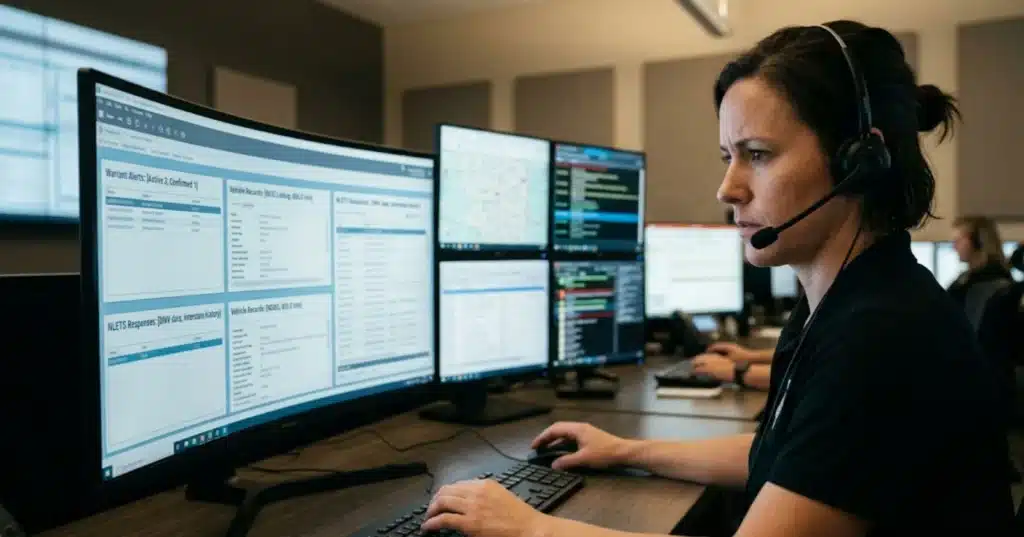
In dispatch, time is critical. With Portal XL, warrant checks can run in real time, so that you can instantly respond to a 911 call. Alerts for stolen vehicles or flagged individuals come through automatically, while Nlets responses land in one inbox.
You won’t have to hop across systems, allowing you to make faster decisions and enhance situational awareness for dispatch and units in the field.
Patrol Officer Field Queries
For patrol officers, simplicity and speed are essential.
Officers can perform license plate and VIN lookups directly from in-vehicle workstations without returning to the station. Person background checks return results from multiple systems in a single view.
Sex offender registry verification and local intelligence checks are available without switching applications.
This allows officers to stay focused on their surroundings while accessing critical information.
Detective Investigations
Detectives usually need deeper and wider access to criminal justice data. Portal XL makes that easier, supporting interstate criminal history requests and out-of-state vehicle checks without the usual system-hopping.
Instead of piecing things together from different sources, investigators can pull what they need across jurisdictions in one place.
With consolidated query results and detailed transaction history, detectives can review everything they need from a single interface, leading to more thorough work and, ultimately, stronger case outcomes.
Addressing Common Concerns About Unified Portal Systems
Data Security and Compliance
Security remains a top priority for any CJIS-compliant database portal.
Portal XL uses encryption for data transmission and enforces strict authentication protocols. Audit logging ensures that all activity is recorded and traceable.
Role-based access controls limit data exposure based on user responsibilities. These measures help agencies maintain compliance while improving access. This is one of the key reasons why browser-based portals are safer for agencies than installed software.
System Reliability and Uptime
When your portal goes down during a traffic stop in the middle of the night, officers will be forced to confront the situation. They could face possible threats unknowingly, and that’s something you’d want to avoid as much as possible.
Portal XL supports redundant infrastructure within the agency environment. This means that if one component fails, you’ll have a backup to lean on, so your operations can continue like normal.
Failover mechanisms maintain access during outages. Performance remains stable during peak usage, supporting high-demand scenarios.
Integration with Existing Systems
Agencies don’t need to replace their existing systems to adopt Portal XL. The platform is highly customizable and adapts to each agency’s specific needs. With high-quality hands-on support, your suggestions for improvements are promptly implemented and carried forward across versions.
Legacy system support ensures that agencies can modernize access without abandoning existing investments. Migration pathways provide a structured approach to implementation.
The Future of Criminal Justice Database Integration
Expanding Data Sources
The future of law enforcement database integration is heading towards more connections and better visibility. As additional state repositories and regional intel networks come online, coverage gets stronger.
Federal systems will keep evolving, too. As data access improves, agencies gain better visibility into query patterns and operational activity to get ahead of incidents, not just reacting to them.
Mobile and Remote Access
Portal XL supports access from in-vehicle workstations and agency-approved devices within the agency network, giving officers and dispatchers consistent access to
NCIC, NLETS, and state databases from the field.
Simplify Criminal Justice Database Access
Law enforcement technology has come a long way, and agencies no longer need to be limited by fragmented criminal justice database access. Unified portal systems provide a practical solution by consolidating access to federal, state, and local databases.
PsPortals reduces query times significantly by consolidating access into a single interface, improves data accuracy, and simplifies system management. Officers gain faster access to critical information, while IT teams benefit from reduced complexity.
The question for agency leaders is straightforward. Are your officers still switching between multiple systems? If your current setup is holding your agency back, start by assessing your portal vendor readiness. During a background check, are they equipped with a unified criminal justice portal that delivers complete information in seconds?
Frequently Asked Questions
Why isn’t there a single national criminal records database?
Criminal justice data is distributed across federal, state and local jurisdictions. Each of the levels maintains control over its own records due to legal, operational, and governance requirements. This structure ensures the data accuracy and accountability but prevents full centralization.
How does Portal XL maintain CJIS compliance while accessing multiple databases?
Portal XL adheres to CJIS standards via encryption, secure authentication, audit logging and role-based access controls. All the queries and data exchanges are tracked and protected in accordance with CJIS requirements.
Can officers query multiple databases simultaneously or do they have to wait for each response?
Depending on the transaction, officers can submit a single query which is then sent to multiple databases at the same time. Results are returned and compiled into one interface, which removes the need to wait for each system individually.
What happens if internet connectivity is lost during a critical query?
Agencies can design their deployment with redundancy and failover mechanisms. If the connectivity is disrupted, the systems can still reconnect and resume the operations based on the infrastructure setup of the agency.
What training is required for officers to use Portal XL?
Training requirements are minimized because officers can use a single, consistent interface through a browser interface. PsPortals offers training to your agency’s trainers, so you can efficiently onboard with new users.
How long does it take to implement Portal XL across our agency?
The timelines for implementation can vary depending on the system complexity and integration requirements. There are many agencies that can deploy the platform in phases which allows for gradual adoption and minimal disruption.