
Manual, multi-system background checks can take hours, days, or even weeks, which delays essential decisions and critical operations. Automated background check tools for law enforcement complete the exact same search in a fraction of the time, bringing speed to your agency.
Each year, agencies conduct thousands of background checks for investigations, officer safety queries, pre-employment screening, and warrant verification. However, manual methods often come with delays, risk of human error, and a time-consuming investigation process.
Fortunately, automated background checks have revolutionized agency screening and background investigation. In a few clicks, you can obtain accurate and updated criminal background information, warrants, and identification details.
This article helps you learn what automated background check tools are, what they do, and why they matter. It also breaks down how these tools integrate with NCIC/NLETS databases, compliance requirements, and why agencies are shifting towards automation.
But first, it’s important to understand what automated background check systems for law enforcement really mean.

What Are Automated Background Check Tools for Law Enforcement?
Automated background check tools for law enforcement consist of high-tech software solutions that search and retrieve criminal records from multiple databases without manual data entry and repetitive queries.
These platforms integrate with NCIC, NLETS, state criminal repositories, and local records management systems, granting instant access to warrants, criminal histories, records of stolen property, and missing persons data.
Automation eliminates manual lookups, reduces query time from minutes to seconds, and maintains CJIS compliance through built-in security controls and audit logging.
Core components of an automated background check software include:
Database Integration
You can connect law enforcement background screening software directly to NCIC, NLETS, state repositories, and court records to get all the criminal justice information you need.
Automated Query Processing
The system executes queries automatically using predefined rules or triggers, significantly reducing the need for manual intervention.
Identity Verification
Automated criminal history checks authenticate identities using SSN verification, DMV photos, or biometric matching. They mitigate risks of mistaken identity by cross-referencing multiple biometric and data sources.
Real-Time Results
Automation lets you submit queries and receive instant returns of complete criminal histories, warrants, and personal file data, so you can make confident decisions on the fly.
Compliance Controls
A police background verification system maintains audit trails and employs robust data encryption and strict access controls to adhere to stringent CJIS security enforcement. All sensitive information is handled securely and ethically throughout the entire process.
Alert Systems
Automated alerts immediately notify officers of active warrants, matches with violent offenders, or gang affiliations. These notifications facilitate swift operational responses. They serve as critical situational awareness tools for law enforcement personnel.
Core Capabilities of Automated Background Check Systems
A law enforcement background screening software is designed to scan vast amounts of data in mere seconds. With their powerful capabilities, they perform multiple searches across different databases to verify accuracy in background checks.
Multi-Database Search Automation
Police background verification systems simultaneously query NCIC, NLETS, warrant databases, and local RMS systems. That’s a huge sigh of relief, as you can obtain the entire criminal profile in seconds rather than searching each system individually.
Pre-Employment Background Screening
Accelerating the hiring process is one of the primary benefits of automation. It thoroughly checks the job seeker’s criminal record, credentials, employment history, and disqualifying factors. Law enforcement hiring software can identify issues immediately by comparing application information with agency guidelines.
Officer Safety Intelligence
With mobile support devices right on the road, police officers can quickly look up the suspect’s history. They get to see crime summaries, warrant alerts, and gang indicators in a matter of seconds. This detailed information is a valuable asset to officers, as it enables them to manage risk more effectively during their field operations.
Warrant and Stolen Property Verification
Automated warrant verification automatically checks every person and object against lists of stolen vehicles, missing persons, and active warrants. Alerts are instantly triggered the moment someone or something is identified, ensuring a prompt response.
Compliance Audit Trail Generation
Every search is logged with the user, time, and purpose, creating a detailed record. These reports help ensure compliance with the law and facilitate management check-ups. They secure accountability and, at the same time, safeguard the agency from possible conflicts or audit issues.
Biometric Integration
The comparison of fingerprints and faces accelerates the verification process and simultaneously reduces errors in the identity verification process. Police booking, arrests, and investigations benefit from verified biometric matching.
Automated Data Validation
Automated systems verify data format, missing fields, and mistakes before sending queries. This minimizes rejected inquiries and enhances the quality of data sent into criminal justice databases.

The Critical Role of Database Access in Background Check Automation
Automated background checks are only as effective as the database access powering them. The foundation of successful automation is secure, immediate connectivity to criminal justice information systems.
The Database Access Challenge:
Background check automation imperatively demands continuous, reliable access to these critical systems:
NCIC
Warrants, criminal histories, stolen property, missing persons, gang files
NLETS
Interstate message switching, out-of-state queries, multi-jurisdictional data
State Criminal History Repositories
Conviction records, arrest histories, sex offender registries
Local RMS Systems
Agency-specific incident reports, case files, booking records
Legacy database access methods hinder the operational efficiency of your agency. Multiple logins, antiquated interfaces, and VPN requirements not only create bottlenecks but also increase IT expenditures. Outdated infrastructure actively obstructs the full advancement of automation within your department.
How PsPortals Portal XL Powers Background Check Automation
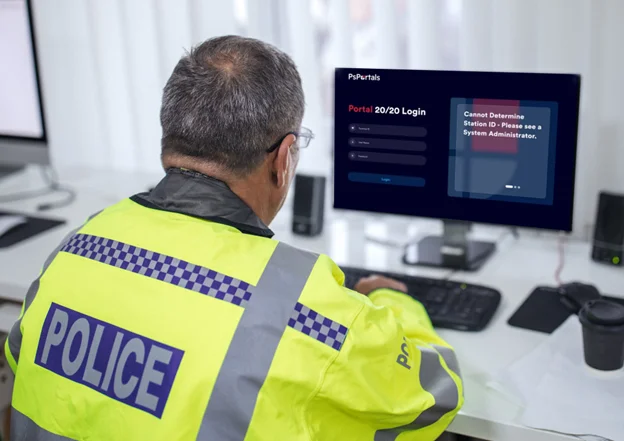
PsPortals’ Portal XL is an automated background check tool for law enforcement that expedites tedious background checks for your agency. Find out how below.
Portal XL provides quick, zero-footprint database access
The officers steer clear of tasks such as device installation, patching, and configuration. The simplicity of it all significantly reduces the deployment time and also cuts down on maintenance in the long run.
Portal XL eliminates infrastructure complexity by consolidating NCIC, NLETS, and state repository database accesses into a single web-based workspace.
Portal XL streamlines background checks with instant query capabilities
When connected to a law enforcement background screening software, Portal XL supports automated background checks by:
- Providing instant NCIC/NLETS query capability without system switching
- Enabling bulk query processing for pre-employment screening
- Delivering results in seconds, not minutes, for officer safety queries
Your agency can run more efficiently and effectively handle critical incidents.
Portal XL ensures security and CJIS-compliance across all activities
Data security is a top priority in law enforcement. Portal XL meets federal CJIS Security Policy requirements through:
- Multi-factor authentication and role-based access controls for secure and authorized access
- Encrypted data transmission for all database queries to eliminate cyber threats
- Comprehensive audit logging of every background check performed for complete audit trails
- Automated compliance monitoring and reporting that saves you from compliance stress
Portal XL safeguards sensitive criminal justice information so that your law enforcement agency can operate with confidence.
Portal XL handles high-volume, continuous operations
If your agency handles thousands of background checks monthly, a scalable solution like Portal XL can be a reliable ally to:
- Handle simultaneous multi-user query environments without performance degradation
- Scale operations without purchasing additional hardware or licenses
- Maintain 24/7 availability for around-the-clock background screening needs
- Reduce per-query costs through efficient cloud-based architecture
Law enforcement agencies handle tons of data daily, and there’s simply no room for slow operations.
Portal XL integration provides several benefits for your agency
When Portal XL connects with background check automation tools, agencies gain:
- Faster turnaround with targeted queries completed in seconds to minutes vs. several minutes to even hours manually
- Higher accuracy as automated validation and less manual data entry reduces errors
- Broader coverage offering seamless access to federal, state, and local databases
- Lower costs due tozero-footprint deployment that minimizes infrastructure and IT expenses
- Audit readiness with automatic and complete generation of compliance documentation
With Portal XL by your side, accessing and handling sensitive criminal justice information becomes a driving force for a better public service.
Portal XL supports a smooth investigative workflow:
- An investigator identifies the need for a criminal history check.
- They log in via a secure, unified Portal XL interface.
- They select NCIC, NLETS, or other databases.
- The system sends automated queries without disrupting workflow.
- Results appear instantly within the portal.
- Data adds to the report with an automatic audit trail.
- Reports are saved and shared securely.
Types of Automated Background Check Tools
No single tool handles all background check scenarios. Some tools automatically flag criminal records, some provide unified background check reports, while others help with licensing and permitting. Here are the most common types of automated background check tools that solve different problems to address agency needs.
Pre-Employment Screening Platforms
These are specialized software for vetting law enforcement job applicants’ backgrounds. They do things automatically like collect PHQs (Personal History Questionnaires), check criminal records, verify employment, analyze social media, and report credit. Examples include Guardian Alliance Technologies’ triage system.
Officer Safety Intelligence Tools
These are mobile-enabled systems that offer real-time background screening and active signal alarms during field encounters. Officers can query databases from patrol vehicles, receiving instant warrant status, criminal histories, and threat indicators, enhancing. This enhances rapid judgment and situational acuity, which translates to improved safety for officers and civilians alike.
Hiring Background Investigation Software
These tools offer comprehensive case management systems supporting full background investigations for police recruits. They track investigation progress, flag disqualifying factors, and generate compliance reports throughout the hiring process.
Regulatory Background Screening Solutions
Regulatory background screening tools help licensing and permitting agencies verify applicants before giving them credentials. By combining state and federal criminal databases, identity checks, and risk assessments, these systems automate record searches, surface disqualifying issues early, reduce errors, and speed up compliance decisions.
Biometric Background Verification
Biometric background verification tools use fingerprints and facial recognition to quickly check identities against large criminal databases. The FBI’s NGI system, for instance, has over 217 million fingerprints in it. This feature speeds up the time it takes to process bookings and arrests.
Multi-Database Query Aggregators
These platforms consolidate searches across NCIC, NLETS, state repositories, court records, and proprietary databases, returning unified background reports from a single query. Portal XL serves as the backbone for secure and efficient data access.
The Integration Imperative
The right integration lets you create an efficient ecosystem where speed, accuracy, and coverage mutually reinforce one another. Successful agencies combine specialized automation tools with reliable database access platforms like Portal XL to achieve the best results.

Key Benefits of Automated Background Check Tools
Automated background verification tools save time and reduce the need for human labor. They also enhance officer safety, improve recruiting accuracy, promote compliance, reduce human error, and facilitate case resolution.
Dramatic Time Savings
Automation reduces processing times by up to 90%. What was once a long manual search that took 15 to 45 minutes can now be completed within a minute. This lets investigators focus more on analysis rather than data retrieval.
Increased Officer Safety
Real-time automated background checks provide officers with immediate threat intelligence during field operations and high-risk encounters. Warrant status, violent offender indicators, and gang affiliations appear instantly, informing tactical decisions and reducing risk.
Improved Hiring Accuracy
Automated checks ensure thorough vetting and flag unsuitable candidates early, eliminating training mistakes, minimizing unnecessary training, and mitigating associated operational risks.
Enhanced Compliance
Automated audit logs, secure data encryption, and role-based access controls support full CJIS compliance without additional administrative work.
Cost Efficiency
You can process higher query volumes with fewer staff, resulting in a decreased cost per query and allowing savings for other critical areas or scaling your agency as necessary.
Reduced Human Error
Through automation, you can avoid manual mistakes in data entry, like typos, transposition errors, and missing records, and improve the quality of all records.
Faster Case Resolution
Automated link analysis reveals hard-to-notice connections while instant access to background data accelerates case development. Combined, your agency can deliver justice and strengthen public safety.
Implementation Considerations for Law Enforcement Agencies
It’s crucial to identify the specific use cases for the effective implementation of automation in law enforcement. Your law enforcement agency should consider the existing database access, CJIS compliance, and integration capabilities when establishing a robust and efficient operational foundation.
Define Clear Use Cases
Choose an automation tool that’s designed to help with your agency-specific needs, such as pre-employment screening, officer safety queries, investigative background checks, and warrant verification.
Assess Current Database Access
Evaluate existing NCIC/NLETS connectivity. If your agency lacks reliable database access, you should implement browser-based solutions like Portal XL to provide a secure foundation for background check automation platforms.
Ensure CJIS Compliance
Only use automated background check tools that meet CJIS Security Policy requirements. Select vendors demonstrating CJIS certification, advanced encryption, and verifiable audit processes to maintain legal compliance and data integrity.
Plan Integration Strategy
Verify seamless interoperability of new systems with CAD, RMS, and legacy architectures. Check API availability, data format compatibility, and most importantly, expert vendor support for integration projects.
Budget for Training
Set aside sufficient funding to make sure staff are well-trained on automation tools and know how to use criminal justice databases effectively and responsibly. Ongoing training helps teams stay confident, capable, and up to date as systems and security requirements evolve.
Start with Pilot Programs
Initiate targeted pilot deployments, gather performance metrics, and iteratively refine workflows before deploying them organization-wide.
Address Community Concerns
Law enforcement always starts with the community. Be transparent about the use of automated background check software, present a clear privacy policy, and communicate with your community to lessen opposition.
Leverage Grant Funding
Federal and state programs support law enforcement technology modernization. Remember to obtain DOJ grants, COPS funding, and state criminal justice improvement programs, as they help agencies acquire automation tools, so you don’t have to shoulder too much capital expenses.
Successful automation deployment and public trust are achieved through strategic pilot programs, open community engagement, and well-used grant funding. By balancing technology, processes, and budgets, your agency can build compliant, scalable automation that’s practical for daily policing operations.
Real-World Success Stories
Real-world success stories show how advanced technology delivers real results. Proven implementations demonstrate scalability, data integrity, and reliable performance, which confirms these systems can hold up under everyday operational and compliance demands.
Mid-Size Agency Pre-Employment Screening
A 200-officer agency reduced its recruitment investigation time in half by using automated background checks. The system flagged disqualifying factors 40% earlier than manual review, allowing the agency to reject two unsuitable candidates. That move saved them $80,000 in wasted training costs.
Large Urban Department Officer Safety
Major metropolitan agencies deployed mobile background checks that deliver 95% of results within 30 seconds. Previously, radio-dispatched manual inquiries consumed 10–15 minutes. Officers now access real-time warrant and criminal history intelligence from patrol vehicles, improving field safety and response precision.
State-Level Licensing Background Checks
A state regulatory agency that runs over 50,000 background checks per year for professional licensing shifted to automated criminal history queries with state repository integration. This lowered processing time from 14 days to 2 days, and the rate of error decreased by 85%.
Common Success Factors
Agencies that have seen success in adopting automated background check tools for law enforcement have several common key factors:
- Reliable database access infrastructure, like Portal XL, as a foundation
- Clear policies documenting when and how automated tools are deployed
- Adequate staff training on tools and compliance
- Expert vendor support during implementation and ongoing assistance
When these elements come together, your agency will have a higher chance of success in implementing automated background check tools.
The Future of Background Check Automation
Automating background checks is a necessity in the information age. The urgency of real-time information availability allows for effective law enforcement.
AI-Powered Risk Assessment
Machine learning algorithms analyze criminal patterns and risk levels to help agencies prioritize reviews. This speeds up evaluations and increases the accuracy during the hiring process or investigative checks.
Simplified Reporting with NLP
NLP facilitates the interpretation of complex criminal histories into plain-language reports to identify relevant offenses and patterns for faster decision-making.
Tamper-Proof Audit Trail via Blockchain
Immutable logs will ensure every check remains verifiable and protected. Agencies gain transparent, secure documentation for audits and regulatory reviews.
Cross-Jurisdictional Access
Federated systems allow multi-jurisdictional searches while respecting data sovereignty rules, providing broader and more efficient access.
Automatic Identity Verification
Biometric systems verify identities instantly, reducing fraud and expediting onboarding or arrest workflows.
The Essential Future Foundation
Technological evolution has come a long way and will continue to do so in the future, but reliable database access will still remain essential. Platforms like Portal XL will provide the foundational infrastructure powering next-generation automation.
Frequently Asked Questions
Q1: What is the difference between manual and automated background checks?
Manual checks rely on staff reviewing records individually, which takes significant time. Automated systems gather data instantly from criminal justice databases, like NCIC, state repositories, and court records, reducing effort and errors. Automation offers scalability, precision, and faster outcomes.
Q2: Are automated background check tools CJIS-compliant?
Not all automated background check systems are CJIS-compliant. Choose platforms that fully comply with CJIS Security Policy requirements and feature MFA, encryption, access controls, and automatic audit and compliance capabilities. Remember to verify the compliance of the vendors at all times.
Q3: How much time do agencies save with automation?
Automation shrinks query turnaround time from minutes to seconds and infestation times from days to minutes. With law enforcement background screening software, your agency can handle more cases without recruiting new personnel.
Q4: Can automated systems access NCIC and NLETS databases directly?
Some tools offer direct integration, but strict CJIS Security Policy requirements must be met to achieve this level of integration. Agencies should confirm compliance and technical capability before implementation.
Q5: Do small police departments benefit from automation?
Yes, automation makes small agencies more efficient and accurate, which compensates for their limited staff. Small police departments can use advanced screening since there are cheap alternatives. Licensing authorities use specialized background checking software to automate criminal history checks from both state and federal sources.